Tokenized Treasuries: The Part of RWA That Plainly Works
Government debt wrapped in a token. The least exciting corner of crypto and the one holding most of the real-world value onchain.
The short answer
A tokenized Treasury is a token representing a share in a fund holding short-dated government debt, or in some structures a direct claim on the bills themselves. Yield accrues either by the token's price rising or by new tokens arriving in your wallet, and it comes from the government paying interest rather than from anyone newer buying. That last property is why this is the largest working category in RWA. The trade-offs are that most issuers restrict who may hold and redeem, the yield falls when policy rates fall, and you have swapped market risk for the credit of an issuer and a custodian.
Of everything filed under real-world assets, this is the part that works, and it works for reasons that have nothing to do with being onchain.
What you are holding
Usually a share in a fund that buys Treasury bills and overnight repurchase agreements, issued as a token. The structures differ in how the yield reaches you: some tokens are rebasing, so the balance in your wallet grows; others accrue value so one token is worth progressively more. Neither is better, but the difference matters for accounting and for how a lending market prices the token as collateral.
Why this category functions and the others struggle
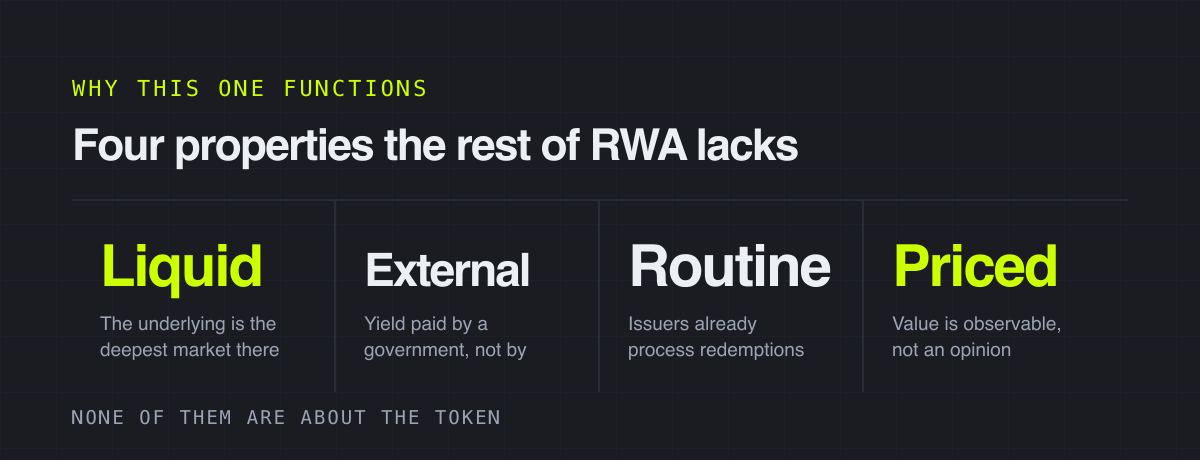
Because the underlying already has everything tokenization cannot create. It is the most liquid instrument in existence, it is priced continuously by a market far larger than crypto, the issuers process subscriptions and redemptions as ordinary daily business, and the yield is paid by a sovereign rather than by an incentive schedule.
Compare that with a tokenized building, where the token is fine and the asset underneath has no daily price, no routine redemption process and no buyer waiting.
What it is actually used for
- Parking idle balances at a yield that does not depend on crypto conditions – treasuries for treasuries, mostly corporate rather than retail.
- Collateral in lending markets, where a yield-bearing asset is strictly better than a stablecoin that pays nothing.
- The reserve behind some yield-bearing stablecoins, which is the same instrument one layer down.
- A place to sit between trades without leaving the chain, for anyone large enough that the yield exceeds the friction.
The honest limitations
Most of it is not open to you
Minimums are frequently institutional and eligibility is often restricted to qualified or non-US investors. A retail holder frequently meets this category through a yield-bearing stablecoin or a lending market rather than by holding the token directly.
The yield is a policy rate
It is attractive because short rates are. When they fall, the product does not become more attractive relative to anything – it just pays less, and the narrative around it cools accordingly.
You hold a claim, not a bill
Issuer and custodian risk are real and are the risk you accepted in exchange for the market risk you avoided. Compliant structures generally permit the issuer to freeze tokens, and that is documented rather than hidden.
What to check
- Who the issuer is, under which regulator, and who the custodian is.
- Whether reserves are attested, by whom and how often.
- Redemption terms: who may redeem, at what minimum, and how quickly.
- Whether the yield accrues by rebasing or by price, because it changes how everything downstream treats it.
- Whether there is a secondary market, or whether exiting means redeeming through the issuer –
 DefiLlama RWA is the neutral scoreboard for the category.
Tools mentioned
FAQ
What is a tokenized Treasury?
A token representing a share in a fund holding short-dated government debt, or a direct claim on the bills. Yield reaches the holder either by the balance rebasing upward or by each token becoming worth more, and it is paid by the government rather than by new buyers.
Why are tokenized Treasuries the biggest RWA category?
Because the underlying already has what tokenization cannot create: continuous pricing, enormous liquidity, routine daily redemption, and yield from outside crypto. Tokenization adds settlement speed and composability to an instrument that was already working.
Can anyone buy tokenized Treasuries?
Often not directly. Many issuers restrict holding and redemption to qualified or non-US investors and set institutional minimums. Retail exposure usually arrives indirectly, through a yield-bearing stablecoin or a lending market that holds the instrument as reserve or collateral.
More from the blog
Social Trading vs Copy Trading: Not the Same Thing
One shows you what people are doing and leaves the decision with you. The other takes the decision away. That difference is the entire product.
Reading a Memecoin Community Before You Buy Into It
A busy Telegram is not demand. Four things separate a community from a room that was paid to look like one.

RWA Tokens: What Is in the Basket, and What It Owns
Every list of real-world-asset tokens mixes three unrelated things. Sorting them takes one question, and most lists never ask it.