Onchain Copytrading vs Copy Trading on an Exchange
Two things share a name and almost nothing else. One shows you a verified track record you cannot check; the other shows you everything and vouches for nobody.
The short answer
Exchange copytrading means following a trader inside a platform that verifies their record, holds your funds and executes both sides for you. Onchain copytrading means pointing a bot at a public wallet address and mirroring what it does on a DEX. The exchange gives you a vetted, audited record and a profit-share fee, with custody and leverage risk attached. Onchain gives you a complete and independently verifiable history and no vetting whatsoever, with the wallet free to stop, change strategy or trade against its own followers. They suit different people and the failure modes do not overlap.
The phrase covers two products that work nothing alike. Knowing which one an article, a review or a leaderboard is talking about saves a lot of confusion, because the advice for one is frequently wrong for the other.
What each one actually is
On an exchange, a trader opts into a programme. The platform computes their performance from its own records, publishes it, and lets you allocate a share of your account to follow them. The exchange executes both sides, takes a cut of your profit, and pays the trader a cut too.
Onchain, there is no programme and nobody opted in. Every address on a public chain has a complete, permanent trading history that anyone can read, and a bot can watch an address and answer each of its swaps with one of yours. The wallet you follow may not know you exist.
The six differences that matter
| On an exchange | Onchain | |
|---|---|---|
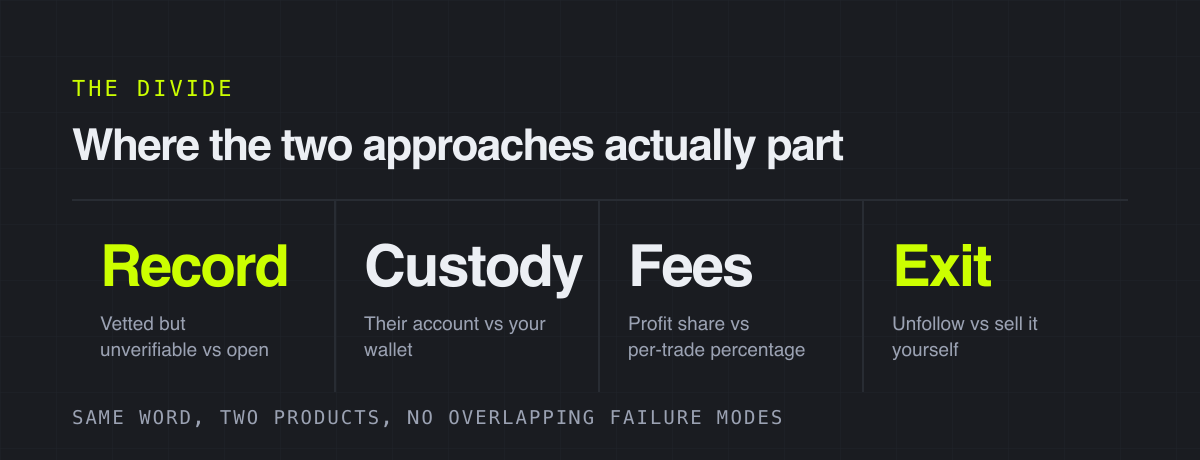
| The record | Verified by the platform, and only as trustworthy as the platform | Complete and independently checkable on the explorer, and vouched for by nobody |
| Vetting | Some – a programme with entry rules and usually a minimum history | None at all. An address is an address |
| Custody | Their account holds your funds | Depends on the bot: your own wallet, or one the bot generated and controls |
| Fees | A share of profit, sometimes plus a subscription | A percentage of every copied trade, both directions, plus pool fees and gas |
| What you can copy | Whatever the platform lists – usually perpetuals on major pairs | Anything the wallet touches, including tokens that did not exist an hour ago |
| Getting out | Unfollow and the platform closes your side | You hold the tokens. Unfollowing stops new copies and sells nothing |
The last row is the one that surprises people
Unfollowing onchain is not an exit. The bot stops acting; your positions stay exactly where they were, and whatever the leader does next happens without you. If you stop following in the middle of a trade, you have inherited it.
What each is genuinely better at
The exchange is better at verification
A platform that runs the matching engine can state a trader's record without ambiguity, and it can refuse to list somebody with three lucky trades. Onchain, you get raw history and no filter, and reading it correctly is work most people skip.
Onchain is better at proof
A verified record still asks you to trust the verifier. An address asks you to trust nothing: every trade, every size and every exit is on the chain, timestamped, and you can check any of it yourself. Nobody can revise it later.
The failure modes do not overlap
- On an exchange: a trader running high leverage looks excellent until the week they do not, and your allocation goes with them.
- On an exchange: you are exposed to the platform itself, not only to the trader.
- Onchain: nobody checked whether the wallet is a project selling into its own followers.
- Onchain: the wallet can simply stop, and a quiet address is indistinguishable from a patient one.
- Onchain: your fill is never their fill, and the gap is a cost you pay on every trade.
Which one suits you
If you want leverage on major pairs, an audited record and no interest in reading transactions, the exchange is the product built for that. If you want exposure to tokens that no platform will ever list, and you are willing to read a wallet's history yourself before following it, onchain is the only option – and the reading is not optional, because there is no one else doing it.
FAQ
Is onchain copy trading safer than exchange copy trading?
Neither is safer in general; they fail differently. The exchange adds a counterparty and usually leverage, and removes the need to judge a record yourself. Onchain removes the counterparty and hands you a complete history along with full responsibility for interpreting it.
Can you copy trade memecoins on an exchange?
Almost never. Exchange copytrading lists the pairs the exchange trades, which means major assets and perpetuals. Tokens that launched this morning exist only onchain, so copying anyone into them requires a bot pointed at a wallet.
What happens to my positions if I stop following a wallet?
Nothing. Onchain, unfollowing only stops the bot from opening new copies – the tokens you already hold stay in your wallet, and the leader's later exits no longer reach you. You have to close those positions yourself.
More from the blog
Do You Pay Tax on Memecoin Trades? What Creates an Event
Not advice, and not jurisdiction-specific. A description of which onchain actions tax authorities generally treat as events, and what records you will need if yours does.
A Trading Journal for Onchain Trades: What to Record
The chain already logs every transaction you made. What it cannot log is why you made it, and that is the column the journal exists for.
Paper Trading Memecoins When No Paper Mode Exists
There is no demo account on a DEX. Here is how to practise anyway – and the one thing simulation can never teach you.