What “Smart Money” Means, and When the Label Lies
A wallet that made money is not the same as a wallet that knows something. Telling them apart is the whole skill.
The short answer
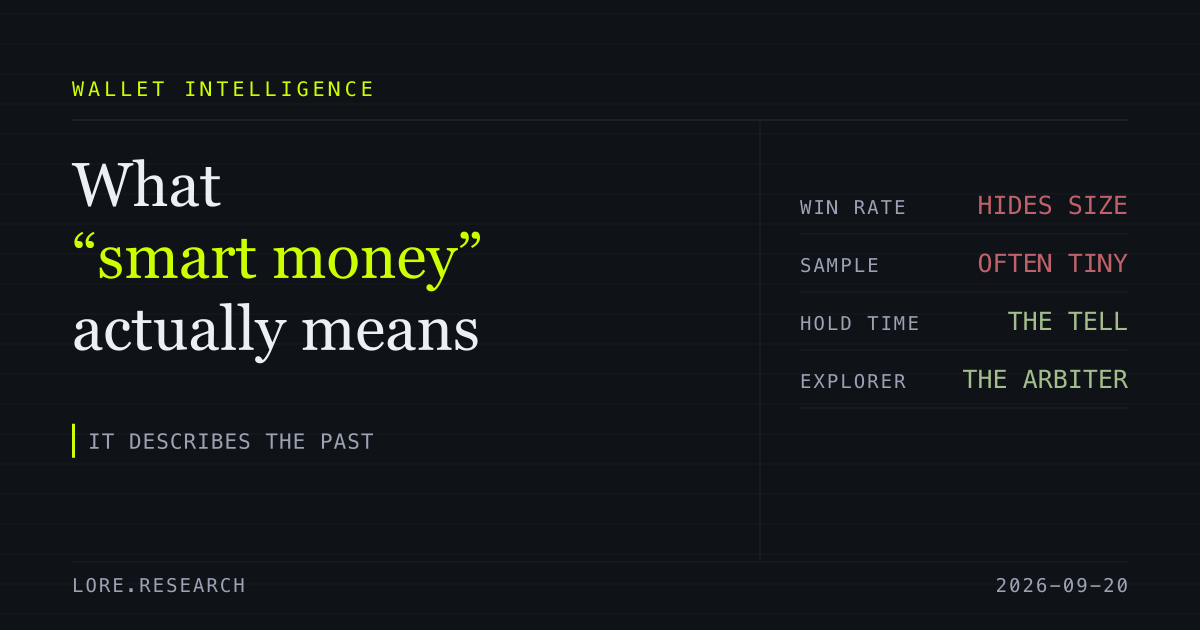
Smart money is a label trackers put on wallets with a strong recent record – high realized profit, a good win rate, early entries into tokens that later ran. It describes the past and nothing else. The label lies in four common ways: a spectacular percentage over three trades is noise, a high win rate can hide one catastrophic loss, a wallet may be one of many belonging to a project selling into you, and a wallet that knows it is watched can trade for the audience. Read trade count, average size and hold time before you read the headline number, and verify anything surprising on the explorer.
Every wallet tracker has a smart money list, and the phrase does real work: somewhere on this chain there are people who are consistently early and consistently right, and their addresses are public. The trouble is that the label is assigned by a formula, and formulas rank what is easy to measure.
What the label is actually computed from
Realized profit, win rate, and how early the wallet entered tokens that subsequently ran. All three are backward-looking by construction, and all three can be produced by luck at small sample sizes. A tracker cannot tell the difference and does not claim to.
The four ways it misleads
The sample is tiny
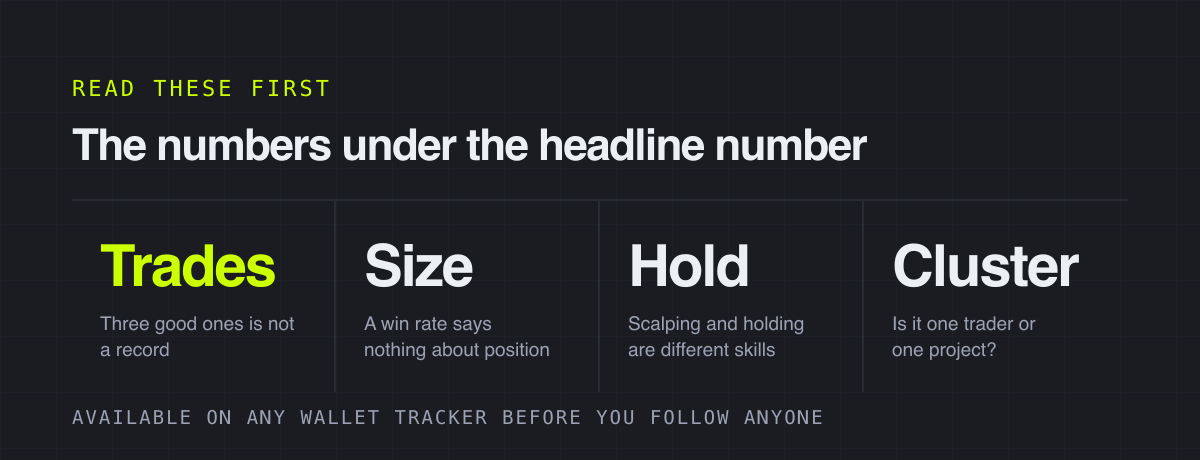
A wallet with three trades and a spectacular percentage is at the top of a leaderboard sorted by percentage. It has told you nothing. Trade count is the first column to look at and the one most often ignored, because the headline number is more exciting.
Win rate hides size
A wallet can win nine trades out of ten and still be down, if the tenth was larger than the other nine combined. Win rate is a count, not a weight. Look for average position size alongside it, or read the realized profit as the number that already accounts for both.
It may not be a trader
A project's own addresses show up as early, profitable and confident, because they were selling rather than trading. Bubblemaps and similar clustering tools exist precisely to answer whether twenty successful wallets are twenty people or one entity with twenty wallets.
It knows you are watching
Public leaderboards change behaviour. A wallet with followers can buy a position knowing the copiers will arrive behind it, and sell into them. This is not hypothetical and it is not rare, and it is the specific reason to be sceptical of the very top of any public list.
How to read a wallet properly
- Start with trade count. Under about thirty, treat everything else as noise.
- Read realized profit rather than win rate, then check whether one position produced all of it.
- Look at hold time. A wallet that scalps and a wallet that holds for weeks need completely different behaviour from you.
- Check whether recent entries are still open. A record built on positions that have not been exited is not a record yet.
- Open the address on Blockscout when something looks too clean. The explorer is the arbiter when a tracker and your instinct disagree.
What the good version of this looks like
Follow a small number of wallets you chose on evidence, in a tool that alerts you – StalkChain, Cielo Finance, Nock Scout, RayBot all do this. Three is usually better than thirty, because an alert stream you have learned to ignore is the same as no alerts at all. And remember what an alert is: a report that something happened, not an instruction. The wallet distributing into its own buyers is producing exactly the same notification as the wallet quietly accumulating.
Tools mentioned
 Bubblemaps
 Cielo Finance
 StalkChain
 Nock Scout
 RayBot
FAQ
How do I find smart money wallets?
Wallet trackers rank public addresses by realized profit and win rate; that is the starting list. The work is filtering it – trade count, position size, hold time – and verifying anything unusual on the block explorer.
Is following smart money profitable?
It is exactly as profitable as the wallets you picked, minus fees and the delay between their fill and yours. The selection is most of the outcome, which is why the tool you use to select matters more than the one you use to copy.
Why do copiers underperform the wallet they copy?
Entry lag and exit lag. You buy a little later and sell a lot later, because the wallet's sell is your signal and you are selling into the liquidity it just used. Good wallets copied badly still lose money.
More from the blog
How to Start Trading Memecoins
Six things to set up before the first buy, in the order that stops the common mistakes.
What to Do After a Rug Pull
Nothing gets the money back. Several things stop the next hour being worse than the last one.
How to Spot a Crypto Honeypot Before You Buy
A token you can buy and cannot sell. The tell is in the contract, and it is readable in about a minute.