Can You Set a Stop Loss on a DEX? Honestly, No
There is no such order type on an automated market maker. What terminals sell you instead is a robot watching a price – which is useful, and is not the same thing.
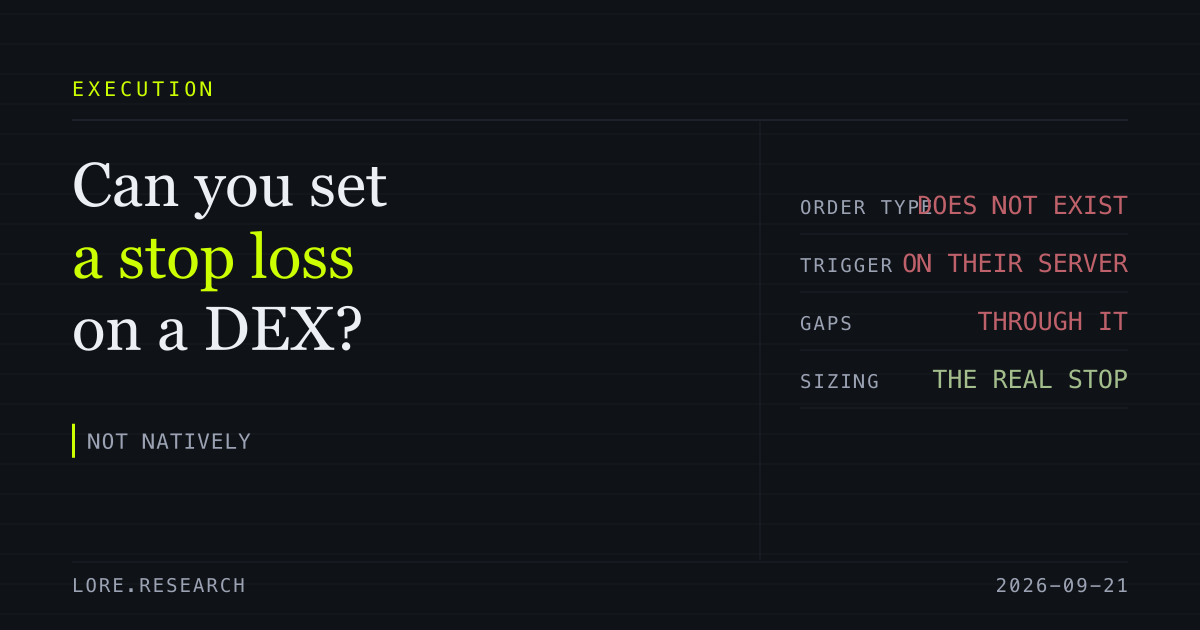
The short answer
A decentralised exchange has no order book and therefore no stop-loss order type: an automated market maker only executes a swap somebody sends it. What trading terminals and bots offer under the name is a server of theirs watching the price and sending a market sell when your level is crossed. That works most of the time and fails in the three situations you would most want it: when their server is down, when the price gaps through your level faster than a transaction can land, and when liquidity has left the pool so the sell fills far below the trigger. Size positions as though the stop may not fire, because sometimes it does not.
The question comes up constantly and the honest answer is short, so here it is first: no, and the thing sold under that name is worth understanding before you rely on it.
Why the order type cannot exist
A stop order on an exchange is an instruction held by the exchange. It sits in their system, watches their order book, and becomes a market order when a condition is met. An automated market maker holds nothing and watches nothing. It is a contract that performs a swap when a transaction arrives, and it has no memory of you between transactions.
There is nowhere in that design for a resting instruction to live. Anything conditional has to be held off-chain by a party that can send the transaction when the condition fires.
What terminals actually give you
A service watches the price. Axiom and Definitive do this from a pro terminal; Maestro and Banana Gun do it from Telegram. When your level is crossed it builds a swap and sends it, signing either with a wallet it holds for you or with an approval you granted in advance. Mechanically it is a robot with your finger, and on ordinary days it does the job.
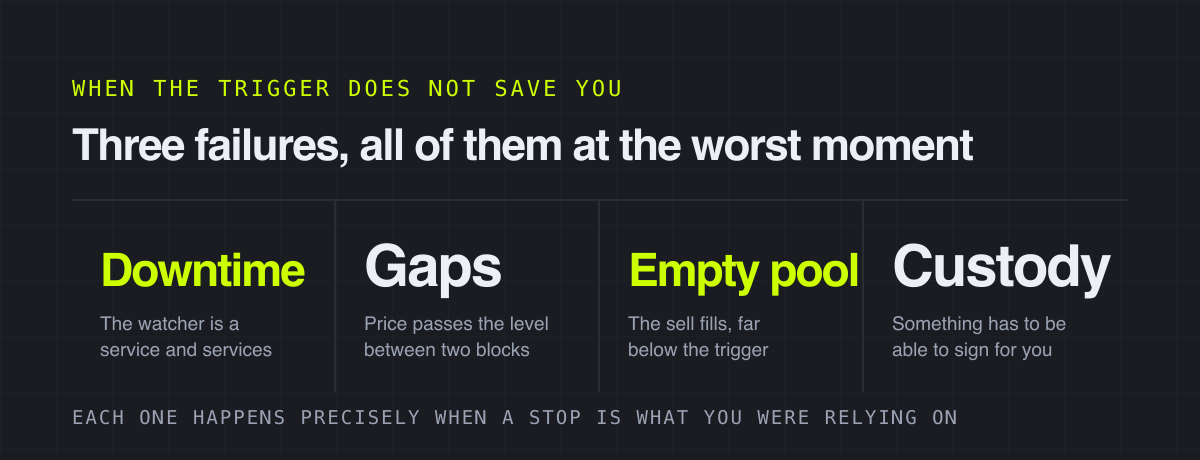
The three ways it fails
Their infrastructure is part of your risk
The watcher is a server. It can be down, rate-limited, mid-deploy or behind on price data, and none of those states are announced to you. A stop held by an exchange is inside the venue you are trading on; a stop held by a terminal is inside a third party you have added to the trade.
Price gaps through the level
On a thin token, one sell can take the price through your trigger and well past it before any reaction can be built, signed and included. The trigger fires correctly and fills at whatever is there, which may be far below where you set it. The stop did not fail; it simply cannot travel back in time.
The liquidity has gone
The worst case is the one a stop is imagined to protect against. If liquidity is pulled, there is no price at which your sell executes for anything meaningful. A trigger on an empty pool produces a transaction, not a rescue.
What to do instead
| Approach | What it costs | What it actually protects |
|---|---|---|
| Position sizing | Nothing, and it works while you sleep | Everything. A position you can lose entirely needs no stop |
| Terminal trigger | Custody or an approval, plus their uptime | Ordinary drawdowns on liquid pairs |
| Price alerts | Your attention, and you may be asleep | Nothing automatically, but you never sell by accident |
| Scaling out | Upside, on the part you sold early | Most of the outcome, most of the time |
The unglamorous entry at the top of that table is the one that works. On assets where a stop can fail exactly when it is needed, the size of the position is the only protection that never has an outage.
If you are going to use a trigger anyway
- Prefer a terminal that signs from your own wallet over one holding your keys to do it.
- Set the level outside ordinary noise, or it will fire on a wick and hand you the loss you were avoiding.
- Do not set one on a pool so thin that the trigger itself moves the price.
- Assume it fires late, and choose a size where late is survivable.
Tools mentioned
 Definitive
 Banana Gun
 Maestro
 Axiom
AxiomFAQ
Can you set a stop loss on DEX Screener?
No. DEX Screener is a screener and a charting front end – it displays pairs and does not execute trades, so there is nothing for a stop to attach to. Setting a price alert there and acting on it yourself is the closest equivalent.
Do any DEXes support stop-loss orders natively?
Order-book venues, including onchain perpetuals exchanges, support conditional orders because they have a book to attach them to. Automated market makers do not, and every stop offered on top of one is an off-chain watcher sending a market swap.
Is a terminal stop loss safe to use?
It is safe in the ordinary sense and unreliable in the specific cases you would most want it. It adds a third party's uptime to your risk, and it cannot help when price gaps through the level or liquidity has left the pool.
More from the blog
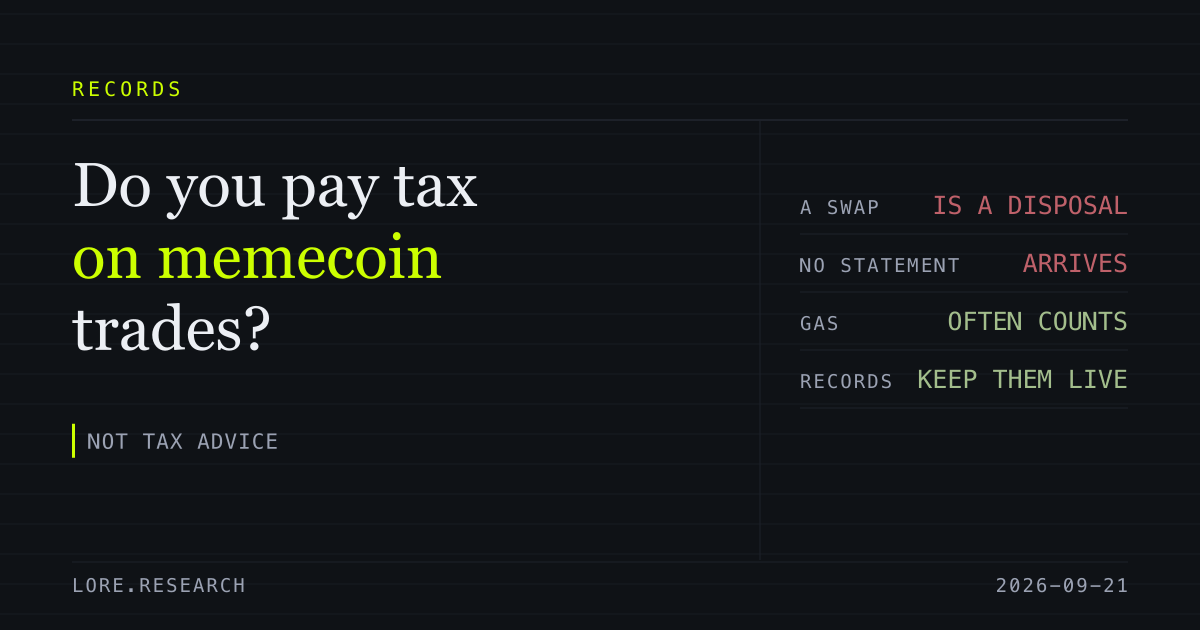
Do You Pay Tax on Memecoin Trades? What Creates an Event
Not advice, and not jurisdiction-specific. A description of which onchain actions tax authorities generally treat as events, and what records you will need if yours does.
A Trading Journal for Onchain Trades: What to Record
The chain already logs every transaction you made. What it cannot log is why you made it, and that is the column the journal exists for.
Paper Trading Memecoins When No Paper Mode Exists
There is no demo account on a DEX. Here is how to practise anyway – and the one thing simulation can never teach you.