A Trading Journal for Onchain Trades: What to Record
The chain already logs every transaction you made. What it cannot log is why you made it, and that is the column the journal exists for.
The short answer
The chain records what you did – every swap, amount, price and timestamp is permanent and exportable from the explorer or a portfolio tracker. A journal exists for what the chain cannot record: why you entered, what you expected, what your exit plan was, and whether you followed it. Ten columns cover it, and only four of them need typing because the rest can be pulled from your transaction history. Review it monthly by grouping trades by reason rather than by result, which is the grouping that shows you which of your reasons actually works.
Onchain traders have an advantage that exchange traders do not: the record already exists, publicly and permanently, and cannot be edited. Every swap, its size, its price and its timestamp is on the chain, readable on Blockscout and exportable in a few clicks.
Which means a journal here is not a bookkeeping exercise. Bookkeeping is done. The journal is for the one thing that never touches the chain.
The ten columns
| Column | Where it comes from |
|---|---|
| Date and time | Transaction history |
| Token and contract | Transaction history |
| Size in and price in | Transaction history |
| Size out and price out | Transaction history |
| Fees and gas | Transaction history |
| Result | Arithmetic on the above |
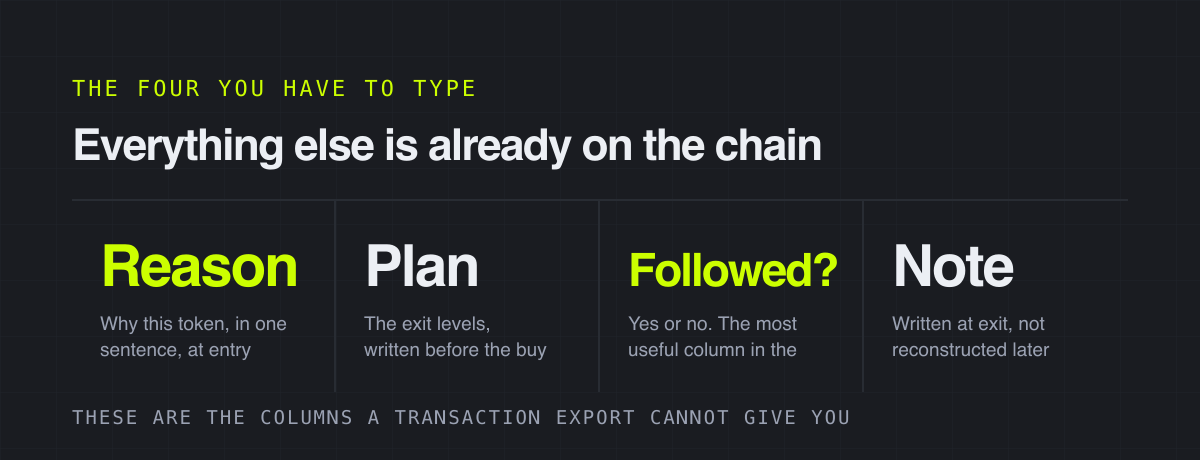
| Reason for entry | You, at the time of entry |
| Exit plan | You, before the entry |
| Did you follow it | You, at exit |
| Note | You, at exit |
Six are exportable. Four are not, and those four are the journal.
Why the reason column has to be one sentence
Because a paragraph is a rationalisation and a sentence is a claim. Written short, reasons become comparable, and after forty trades they sort into a handful of recurring types: a wallet bought it, the holder distribution looked clean, it was early, somebody posted about it, it was already running and I did not want to miss it.
The followed-it column is the one to protect
A yes or no, entered honestly at exit. It separates two very different trades that look identical in a profit column – the one that worked because the plan was good, and the one that worked despite you abandoning the plan. The second kind is where the next large loss comes from, and nothing else in the sheet will flag it.
Where to keep it
A spreadsheet. The tooling question is a distraction: what defeats journals is the friction of the entry moment, and nothing has less friction than a sheet already open in a tab, with DeBank or Zerion supplying the numbers. Sophisticated setups get abandoned in week three.
One practical detail – keep the transaction hash in a column. It makes any row auditable on the explorer later, and it takes one paste.
Fill it at two moments, not one
- At entry: reason and exit plan. Thirty seconds, and it is the thirty seconds the whole exercise depends on.
- At exit: did you follow it, and the note. Written now, while it is uncomfortable, because in two days you will have a better story.
- Never in a weekly catch-up session. A reconstructed reason is the reason you wish you had had.
The monthly review
- Group by reason, not by token and not by result.
- For each reason, count trades and sum the outcome. Reasons with fewer than five trades tell you nothing yet.
- Look at the trades where you did not follow the plan, separately. Their average result is the price of improvisation.
- Change exactly one thing for the next month.
- Do not delete losing rows. The file's only value is that it is complete.
Tools mentioned
 Blockscout Explorer
 DeBank
 Zerion
FAQ
Do you need a trading journal if everything is onchain?
Yes, and for a narrower reason than usual. The chain records every action perfectly, so the bookkeeping half is already done – what it cannot record is why you entered and whether you followed your plan, which is the half that changes future behaviour.
What should a crypto trading journal include?
Ten columns: date, token and contract, size and price in, size and price out, fees, result, reason for entry, exit plan, whether you followed it, and a closing note. Six come from your transaction export; the last four you type.
How often should you review it?
Monthly, and grouped by reason for entry rather than by outcome. Grouping by result tells you which trades won, which you already knew; grouping by reason tells you which of your reasons works, which is the thing you can act on.
More from the blog
Do You Pay Tax on Memecoin Trades? What Creates an Event
Not advice, and not jurisdiction-specific. A description of which onchain actions tax authorities generally treat as events, and what records you will need if yours does.

Paper Trading Memecoins When No Paper Mode Exists
There is no demo account on a DEX. Here is how to practise anyway – and the one thing simulation can never teach you.
How to Take Profit Without Trying to Call the Top
Selling all at once needs you to be right about a moment. Selling in pieces only needs you to be roughly right about a range – which you might be.