FOMO Trading: The Entry You Make at the Worst Price
Fear of missing out is not a character flaw, it is a predictable response to watching a number rise. It is also the single most reliable way to buy the top.
The short answer
FOMO trading is entering a position because the price is already moving and you are afraid of being left behind, rather than because of anything you decided in advance. It produces the worst entries available for a structural reason: the feeling is strongest when a move is most extended, so the urge peaks exactly where the risk does. The countermeasures are mechanical rather than emotional – a written rule about what you will buy, a fixed size so an impulsive entry cannot be a large one, and a deliberate delay between noticing something and acting on it.
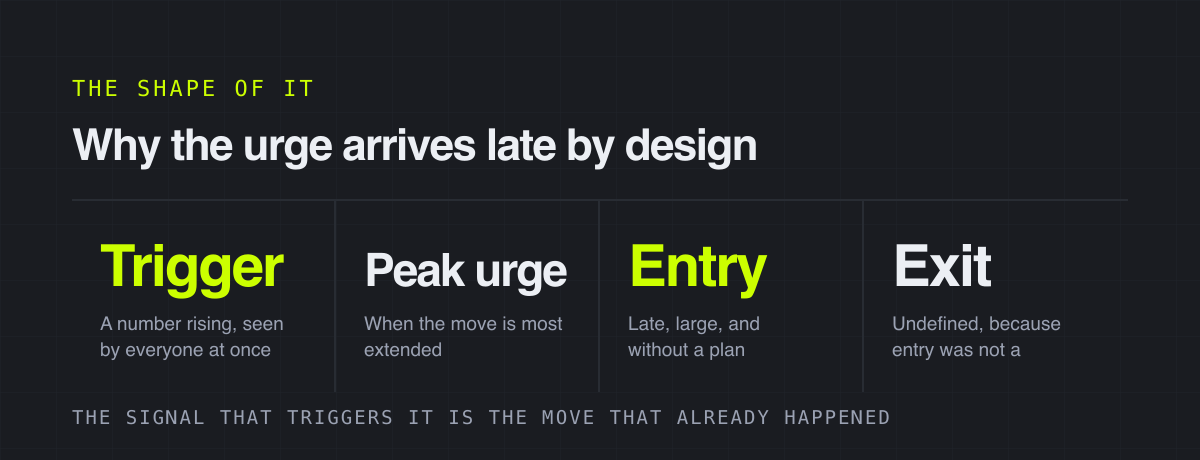
Nobody sets out to buy the top. The sequence that produces it is so consistent it is worth writing down: you see something up sharply, you feel a specific discomfort, the discomfort grows while the price continues, and at some point acting feels better than continuing to watch. That is the whole mechanism.
Why it produces late entries specifically
The feeling is driven by the size of the move, and the move is history. A token up 20% produces mild interest. The same token up 400% produces an urgency that is hard to sit with. So the strength of the impulse is proportional to how much has already happened – which is the same thing as how extended the position you are about to open is.
It is also social. Everybody is looking at the same charts and the same feeds, so the urge arrives for a large number of people at once, which produces the volume that confirms it, which strengthens the urge. That loop is visible on any chart with a vertical section and a long wick above it.
What it does to the rest of the trade
An entry made this way has no plan attached, because there was no moment of deciding. There is no level at which you intended to be wrong, no target, and no size chosen for a reason. Everything after the buy is improvised, and improvisation under pressure produces the second half of the loss: holding through the retrace because selling now would confirm the mistake.
The countermeasures that actually work
A fixed size, decided once
The most effective defence is not resisting the urge but capping what it can cost. If every position is the same size, an impulsive entry is a small loss rather than a memorable one. This works precisely because it requires no self-control in the moment.
A delay
Ten minutes between noticing and buying. Most of what feels urgent does not survive it, and the small number of things that do are still there. The cost of the delay is the occasional missed entry; the benefit is that the entries you do make were decided rather than triggered.
A written rule about what you buy
Not a strategy document – two or three conditions. Minimum liquidity, a holder check, a maximum distance from where the move started. A candidate that fails a written rule is easy to decline; a candidate assessed from scratch while the price is moving is not.
Noticing the feeling by name
This sounds soft and is the cheapest of the four. The urge has a texture – a tightness, a sense that the window is closing. Labelling it as it happens converts it from a reason into an observation, and observations do not place orders.
What it is not
- It is not the same as trading momentum. A planned momentum entry has rules and a stop; this has neither.
- It is not always wrong. Sometimes the late entry works, which is exactly what makes the habit durable.
- It is not cured by knowing about it. Everyone reading this has read something like it before and will still feel it next week.
- It is not a beginner's problem. It scales with account size and with how much you have recently lost.
The honest summary
You will not stop feeling it. The traders who handle it well have not developed immunity – they have built a process where feeling it costs a fixed, small, boring amount. Design for the impulse rather than against it.
FAQ
What is FOMO in trading?
Entering a position because the price is already moving and you are afraid of missing the move, rather than because of a decision made in advance. The urge is strongest when a move is most extended, which is why it reliably produces late entries at poor prices.
How do you stop FOMO trading?
Mechanically rather than emotionally: a fixed position size so an impulsive entry cannot be a large one, a deliberate delay between noticing and acting, and two or three written conditions a candidate has to meet. All three work without requiring self-control in the moment.
Is buying a token that is already pumping always a mistake?
No, and that is what keeps the habit alive – it works often enough to feel justified. The difference is whether the entry has a size, a level at which you are wrong, and a target attached. A planned momentum trade and a panic entry look identical on the chart and behave nothing alike.
More from the blog
Is Crypto Arbitrage Profitable? Yes, and Not for You
The opportunity is real and it is measured in milliseconds. By the time a price difference is visible on a screen, it has been taken.
What a DEX Aggregator Does, and When It Costs You
It searches every pool for the best route and splits your trade across them. That is worth real money on a large order and worth nothing on a small one.
Token Approvals: The Permission You Forgot You Gave
Every swap asks for permission to move a token, and most of those permissions are unlimited and permanent. They stay live long after the trade is done.