What Copy Trading Actually Costs You
The advertised fee is the smallest of the four. Here is the full stack, and the size at which it stops working.
The short answer
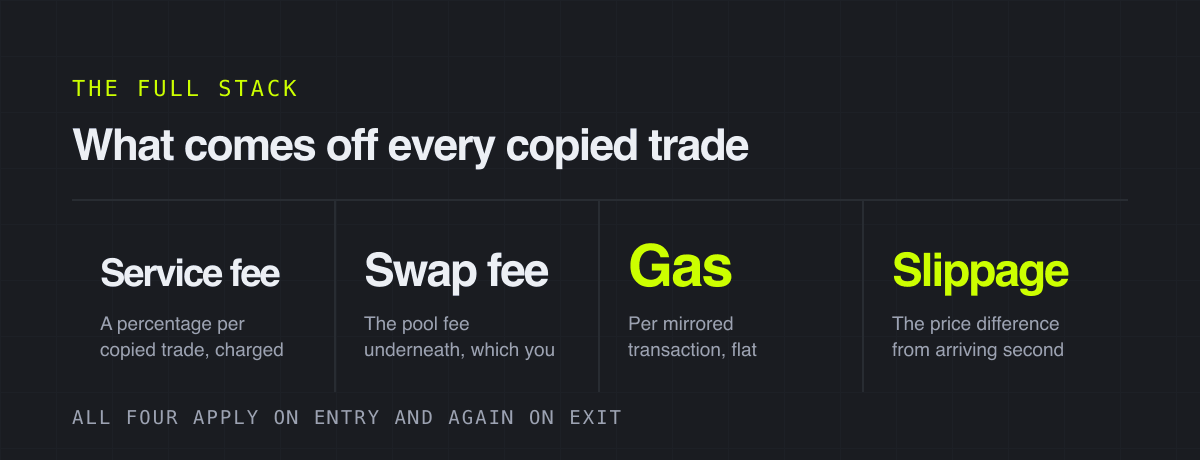
Copy trading costs four things, not one: the service's fee per copied trade, the swap fee underneath it, gas on every mirrored transaction, and slippage from entering after the wallet you follow. On small positions the fixed costs dominate, which is why copying with a small account underperforms the wallet it copies even when every trade is identical.
Every copy trading product advertises one number, and it is the smallest one in the stack. The number that decides whether copying works for you is the sum of four costs, each charged twice – once when the wallet you follow buys, and once when it sells.
The four costs
The service fee is the visible one: a percentage of each copied trade, taken by whatever mirrors the wallet.  GMGN Copy Trade and
  CopyFomo both work this way, and the rate is usually the thing compared between them.
Underneath that sits the swap fee, which goes to the pool rather than the service. On  Uniswap that is 0.05%, 0.30% or 1% depending on the tier, and you would pay it trading manually too – but it is part of the round trip and it belongs in the arithmetic.
Then gas, which is the one that quietly decides everything. Gas is charged per transaction and does not care about your size. The same mirrored buy costs the same whether you put in twenty dollars or two thousand, which means it is a rounding error for one account and a third of the trade for another.
And slippage, which is not a fee but spends like one. You are copying, so you arrive after. On a thin pool the difference between the leader's fill and yours is frequently larger than every other cost combined.
Where the floor is
Because gas is flat, there is a position size below which copying cannot work regardless of how good the wallet is. Work it out rather than guessing: take the round-trip gas cost, add the service and swap fees as percentages, and find the size at which the total is small enough that the leader's edge survives it.
| Position size | Fixed costs as a share | What it means |
|---|---|---|
| Very small | Dominant | The wallet's edge is consumed before it reaches you |
| Small | Material | You need a substantially better wallet to break even |
| Moderate | Noticeable | Copying starts behaving like the wallet it copies |
| Large | Minor | Slippage becomes the binding constraint instead |
The shape matters more than any specific number, because gas and fee rates move. The point is that the curve exists, that you are somewhere on it, and that nobody selling a copy trading product will work out where for you.
The cost that is not a fee
There is a fifth cost with no line item: the trades you copy that the leader did not intend as trades. A wallet rotating liquidity, hedging, or closing an old position produces transactions that a mirror will faithfully reproduce and charge you for. You pay the full stack on each one and get none of the logic behind it.
What to do about it
- Calculate your round-trip cost as a percentage before you pick a wallet, not after.
- Compare wallets on returns after your costs, not on their headline PnL –
 Nock Scout ranks by what a small copier would actually have made, which is the same adjustment.
 - Prefer wallets that trade less often. Frequency multiplies every fixed cost you pay.
- Set a minimum copy size that clears the floor, and skip trades below it rather than taking them at a loss.
- Re-run the arithmetic when gas conditions change. The floor moves.
Copy trading is not expensive in the way people assume. It is expensive in a way that scales inversely with your account, which is the opposite of how most people assume fees work – and it is why the honest answer to whether it pays depends almost entirely on your size.
Tools mentioned
FAQ
How much does copy trading cost?
Four things per copied trade: the service's percentage fee, the pool's swap fee, gas on the mirrored transaction, and slippage from entering after the leader. Each applies on entry and again on exit, so the round trip is double what a single quote suggests.
Why am I losing money copying a profitable wallet?
Almost always fixed costs. Gas does not scale with position size, so on a small account it eats a share of every trade that the leader – trading larger – barely notices. Add slippage from arriving second and a genuinely profitable wallet can be unprofitable to copy.
What is the minimum size for copy trading to work?
The size at which your round-trip gas plus fees is small enough that the leader's edge survives it. That depends on gas conditions and the service's rate, so it has to be calculated rather than looked up – but there is definitely a size below which it cannot work.
Do copy trading fees apply to losing trades too?
Yes. Fees are charged on execution, not on outcome. A copied trade that loses money still costs you the service fee, the swap fee and gas both ways.
More from the blog
Tokenized Bonds Beyond Treasuries: Credit, Coupons and Who May Hold Them
A tokenized treasury is a short government loan with no credit question. Everything else in the bond market has one, and it changes the product.
Tokenized Private Credit: The Yield Is Someone Else's Loan
The highest yields in RWA come from the part with no public market, no daily price and no easy exit. That is not a coincidence.
Tokenized Commodities: What Is Behind the Barrel
Gold sits in a vault. Oil does not sit anywhere convenient, which is why almost every oil token is a fund and not a barrel.