A GMGN Workflow That Takes Ninety Seconds
The interface offers everything at once, which is the problem. Five steps in a fixed order turn it into a filter.
The short answer
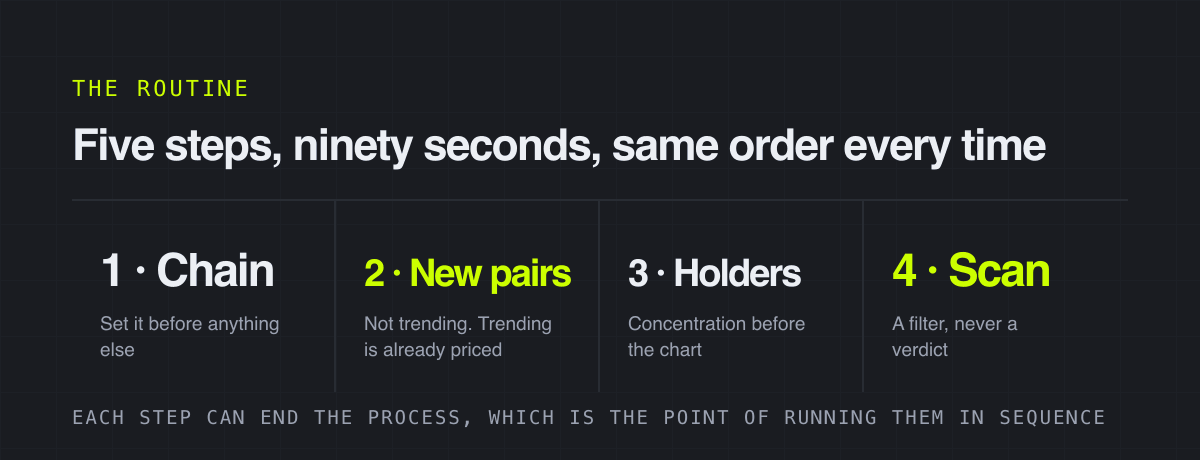
A workable GMGN routine is five steps in order: set the chain, start from new pairs rather than trending, read holders before the chart, run the safety scan as a filter, and size on your own conviction. The order matters more than the steps – the interface presents everything simultaneously and rewards whichever thing catches your eye.
 GMGN has the structural weakness of every all-in-one terminal: it shows you everything at once, so whatever is visually loudest wins. A green candle is louder than a holder table. The fix is a fixed sequence, run the same way every time, so the order of your attention is decided before the screen gets a vote.
One: set the chain
The chain selector is the first thing and the easiest to forget, and a surprising share of confusion with multi-chain terminals is someone looking at the wrong network's data. Set it to Robinhood Chain and confirm it stuck before reading anything.
Two: start from new pairs, not trending
Trending is a ranking of what already has attention. On any screener that includes a paid or engagement-driven component, the list is partly a measure of marketing. New pairs is the feed where information arrives before it has been packaged.
Three: holders before the chart
This is the step that makes the terminal worth its fee. Open the holder view and read concentration and clustering before looking at price. A chart tells you what happened; the holder table tells you who can make the next thing happen.
What you are looking for is not a number but a shape: supply spread across addresses that share a funding source is one holder wearing a crowd, and that is the single most common thing a holder count hides.  Bubblemaps is the second opinion worth taking on anything borderline.
Four: the scan, read as a filter
Run the contract safety scan and treat a clean result as 'no known mechanism found', because that is exactly what it means. It catches sell blocks, mint authority and fee traps reliably. It cannot see a deployer who simply sells, which is how most money is actually lost.
| Step | Ends the process if |
|---|---|
| Chain set | You were on the wrong network – start over |
| New pairs | Nothing new that fits your filters. Close the tab |
| Holders | Concentration or clustering you cannot live with |
| Scan | A mechanical flag you cannot explain |
| Size | The position you would need is larger than your rule |
Five: size on your own conviction
The terminal will show you what other wallets did. Their entry is not a reason for your position, because their exit is a different problem from yours – a wallet that can distribute over three days is solving something you do not have.
- Decide size before opening the terminal, not while looking at a candle.
- If you use the hosted wallet, keep trading size in it and nothing more.
- Verify the contract address on
 Blockscout Explorer before any meaningful position.
- Run the same five steps every time. A routine you vary under pressure is not a routine.
Ninety seconds, and most candidates die at step three. That is the routine working.
Tools mentioned
FAQ
How do you use GMGN?
In a fixed order: set the chain, start from the new-pairs feed rather than trending, read holder concentration and clustering before the chart, run the contract scan as a filter, then size on your own rules. The sequence matters more than the individual steps.
Should I use trending or new pairs on GMGN?
New pairs. Trending ranks what already has attention, which means the people who bought before it trended are looking for buyers. New pairs is where information arrives first.
What should I check before buying from a terminal?
Holder concentration and clustering first, then the contract scan, then the chart. The holder view tells you who can move the price next, which the chart cannot.
Is GMGN's safety scan enough?
It is a filter, not a verdict. It reliably catches mechanical traps like blocked sells and mint authority, and it cannot detect a deployer with a large position who intends to sell it – which is the more common loss.
More from the blog
Prediction Markets: A Price That Looks Like a Probability
A contract paying one dollar if something happens trades at the market's estimate of it happening. The gap between that and a forecast is where the money is.
Staking, and Why There Is None on This Chain
Staking pays you for securing a network. An L2 that settles to Ethereum and charges gas in ETH has nothing for you to secure.
Multisig: Removing the Single Point of Failure
Two of three signatures to move anything. It solves theft and loss at once, and introduces a problem of its own.