Risk-Reward on a Token With No Floor
The ratio assumes you know where you get out. On a DEX with no stop loss, half the formula is missing – and it is the half that matters.
The short answer
Risk-reward compares what you stand to lose against what you stand to gain, and it requires a known exit on the losing side. Onchain there is no stop loss, so the downside is the entire position rather than a distance to a level – which means the ratio has to be built from position size rather than from a price.
Risk-reward is taught everywhere and it is a good idea. Risk one to make three, keep the ratio above a threshold, and a mediocre win rate still produces a positive result. The arithmetic is sound. It also assumes something that does not exist where most people are now trading.
What the formula assumes
The risk side of the ratio is the distance from your entry to your stop. That number is only meaningful if the stop is an instruction someone will execute, sitting on a venue that will honour it while you sleep. On an order book that is exactly what it is.
There is no such instruction on an automated market maker. Nothing is watching the price on your behalf, and nothing will sell for you. A stop onchain means a bot with your keys, and that is a different risk being substituted for this one.
So what is the risk side
The whole position. Not because every token goes to zero, but because there is no mechanism guaranteeing you get out at any particular level – liquidity can vanish, a contract can stop selling, and the price can gap through anything you had in mind while you were asleep.
Rebuilding the ratio so it works
If the downside is fixed at the whole position, then the only variable you control on that side is how large the position is. Risk management stops being about levels and becomes entirely about size, which is less satisfying and considerably more robust.
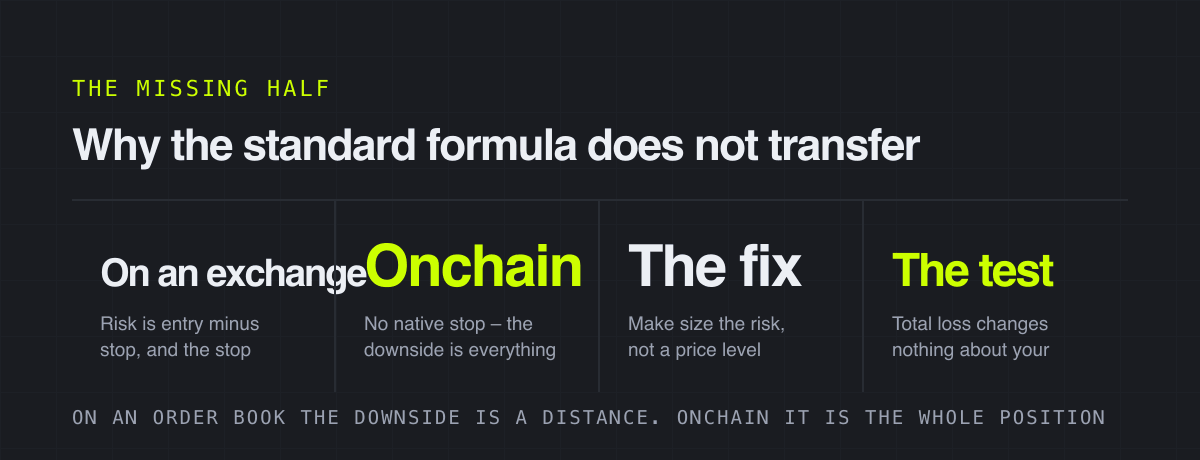
| Order book | Onchain | |
|---|---|---|
| Risk defined by | Distance to the stop | The size of the position |
| Stop executes | Yes, by the venue | Only if you are awake |
| Downside | Roughly known | The whole thing |
| The lever you control | Where the stop sits | How much you put in |
The reward side still works normally. You can have a view on where the token could trade, and you can ladder out of it – taking enough at the first meaningful multiple to return the stake is the closest thing to converting a paper ratio into a real one.
The test that replaces the number
Since the ratio cannot be computed honestly, use the question it was trying to answer. Would losing this position entirely change what you do next? If yes, it is too large, regardless of what ratio you wrote down. If no, you have the risk management the formula was a proxy for.
- Set size first, then find the trade. Reversing that order is how a good setup becomes an oversized one.
- Price in the exit cost. A three-times target in a pool you cannot exit is not a three-times target – check the depth on
 Dexscreener before the entry, not after.
 - Ladder the upside instead of setting one target, because you will not call the top and the ladder does not require you to.
- Write down what would make you exit at a loss, and accept that executing it depends entirely on you.
None of this makes the ratio wrong. It makes it an exchange concept that does not survive the move onchain intact, and the honest substitute is a smaller position than the formula would have allowed.
Tools mentioned
FAQ
What is a good risk-reward ratio in crypto?
On an exchange with working stops, one to two or better is the usual target. Onchain the question changes shape – with no native stop loss the downside is the whole position, so the ratio has to be managed through position size rather than through a price level.
Can you set a stop loss on a DEX?
Not natively. Nothing watches the price on your behalf. Bots can do it, but that means giving something your keys or trade permissions, which substitutes one risk for another rather than removing it.
How do you calculate risk on a memecoin?
Treat the entire position as the risk. There is no reliable exit level on an asset whose liquidity can disappear, so the only honest denominator is what you put in – which makes size the lever instead of the stop.
How much should I risk per trade?
An amount whose complete loss would not change your next decision. That is the question the risk-reward ratio was standing in for, and it survives the move onchain where the formula does not.
More from the blog
Tracking Whale Wallets Without Mistaking Size for Skill
A large balance is evidence of a large balance. Whether it means anything about the next trade is a separate question, and usually the answer is no.
Wallet Tracking You Will Actually Read
Everyone sets up alerts. Almost nobody survives the second week, because the setup was designed to catch everything.

How People Actually Make Money on Memecoins
There are four ways, they are not equally available, and only one of them is what most people are attempting.