How to Take Profit Without Trying to Call the Top
Selling all at once needs you to be right about a moment. Selling in pieces only needs you to be roughly right about a range – which you might be.
The short answer
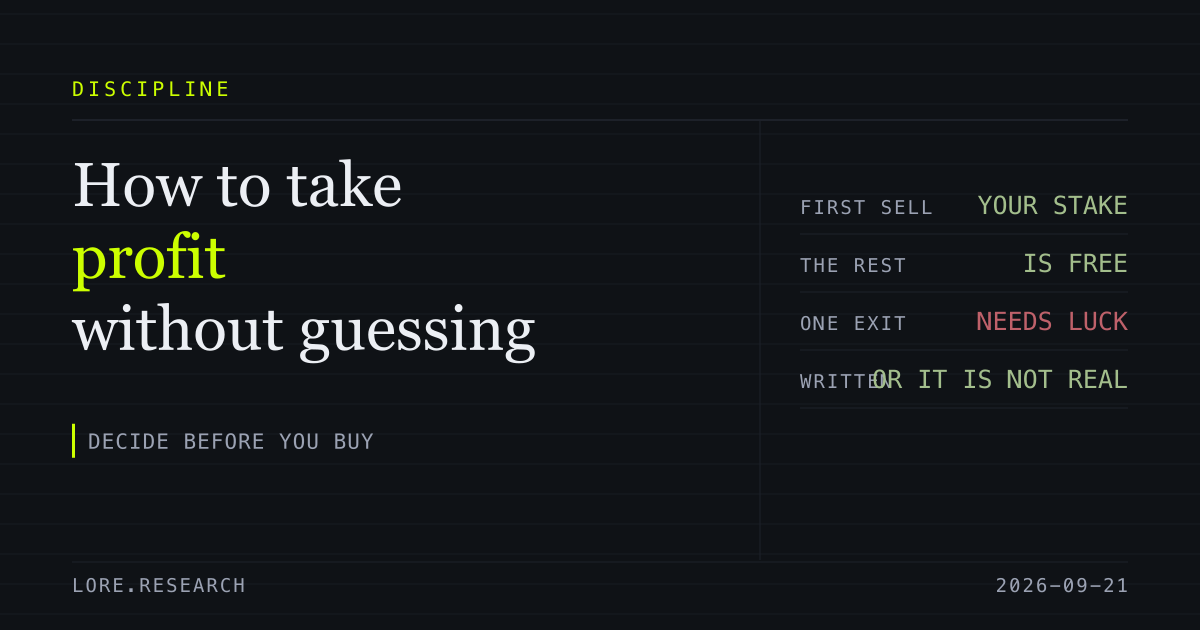
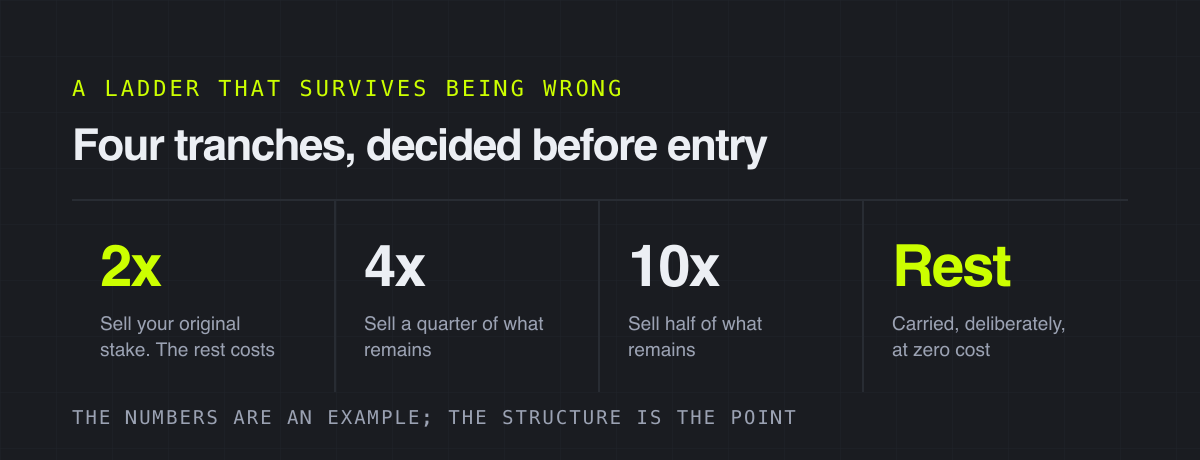
Take profit in pieces at levels you set before you buy. The standard shape is to sell enough on the first significant move to return your original stake, which converts the position into one you cannot lose money on, then to sell further tranches at multiples you decided in advance. This gives up the outcome where you sold everything at the exact top, which requires calling a moment, in exchange for a decent result across every path the price can take. Write the levels down before entering, because the decision is easy when nothing is at stake and nearly impossible when the position is moving.
Nearly everybody plans the entry and nobody plans the exit, which is strange, because the exit is where the money is decided. The entry only determines what you own.
Why one exit is the hard version
Selling the whole position in one action requires you to identify a moment. You have one chance and the feedback is immediate and personal: sell early and you watch it continue without you, sell late and you watch the gain evaporate. Both outcomes teach the wrong lesson, and the next trade is worse for it.
Selling in pieces requires only that your levels fall somewhere inside the range the price visits. That is a much weaker requirement and you can meet it while being substantially wrong.
The first tranche is the only one that matters
On the first significant move, sell enough to recover what you put in. The position that remains cost you nothing, and every decision about it from that point is made without the pressure that produces bad decisions.
Set the levels before you enter
Written down, in the order you will act on, before any money is at risk. The reason is not organisation; it is that your judgment in the middle of a move is not the same judgment you have now, and the version you have now is the better one.
Two things that break the ladder onchain
Your exit needs liquidity your entry did not
Getting into a thin pool is easy; getting a larger position out is the part that fails. Before setting a ladder, check on DEX Screener whether the pool can absorb each tranche, and size the tranches to the pool rather than to the round numbers.
Every tranche is a taxable disposal in most places
Four sells are four events to record. That is not a reason to sell once, but it is a reason to keep records as you go – a tracker such as DeBank or HoodScan does it continuously – rather than reconstructing them later.
Taking profit in what, exactly
Selling a memecoin into another memecoin has not taken profit; it has changed which thing you are exposed to. If the intention is to bank a gain, the proceeds have to land somewhere you are content to hold – a stablecoin or the chain's base asset – and stay there long enough to count.
The part nobody says out loud
A ladder guarantees you will sell some of your best position too early. That is the price, it is paid every single time it works, and it is cheap. The alternative is holding everything to the top, which requires knowing where the top is, and the people who appear to do this are visible precisely because the ones who tried and failed do not post.
Tools mentioned
 Dexscreener
 HoodScan
 DeBank
FAQ
When should you take profit on a memecoin?
At levels decided before you bought, in several pieces rather than one. The most useful first level is whatever returns your original stake, because it converts the position into one that can no longer lose you money and removes the pressure from every decision after it.
Should you sell everything at once or in tranches?
Tranches, unless you have a specific reason to exit entirely. One exit requires you to identify a moment correctly; a ladder only requires your levels to fall somewhere inside the range the price actually visits.
How much should you sell first?
Enough to recover what you put in. The exact multiple depends on the position, but the target is the same: the remainder should cost you nothing, so that holding it is a choice rather than a hope.
More from the blog
Do You Pay Tax on Memecoin Trades? What Creates an Event
Not advice, and not jurisdiction-specific. A description of which onchain actions tax authorities generally treat as events, and what records you will need if yours does.
A Trading Journal for Onchain Trades: What to Record
The chain already logs every transaction you made. What it cannot log is why you made it, and that is the column the journal exists for.
Paper Trading Memecoins When No Paper Mode Exists
There is no demo account on a DEX. Here is how to practise anyway – and the one thing simulation can never teach you.