What Volume Means, and When the Number Is Manufactured
Volume is how much traded, not how many wanted to. Two wallets with a script can produce a week of it in an afternoon.
The short answer
Volume is the total value traded in a period, usually 24 hours. It measures activity, not interest, and it is the easiest number on a token page to manufacture – a pair of wallets trading with each other produces real volume that means nothing, and the fees paid are the cost of the illusion. Read it against two other numbers and it becomes useful: against liquidity, because volume many times the pool's depth is either a very active token or a script; and against the maker count, because four hundred trades from twelve addresses is a different object from four hundred trades from three hundred.
Every token page leads with it and most people read it as a measure of demand. It is not. It is a measure of how much changed hands, and changing hands with yourself counts.
What it actually counts
The total value of trades executed in the window. A single wallet buying and selling the same amount repeatedly adds to it on every leg. The only cost of doing so is the pool fee and the gas, which on a cheap chain makes a large figure affordable to manufacture.
That is not a conspiracy theory about the market; it is a description of what the number can be. It does not mean a given token's volume is fake – it means the number alone cannot tell you.
Reading it against liquidity
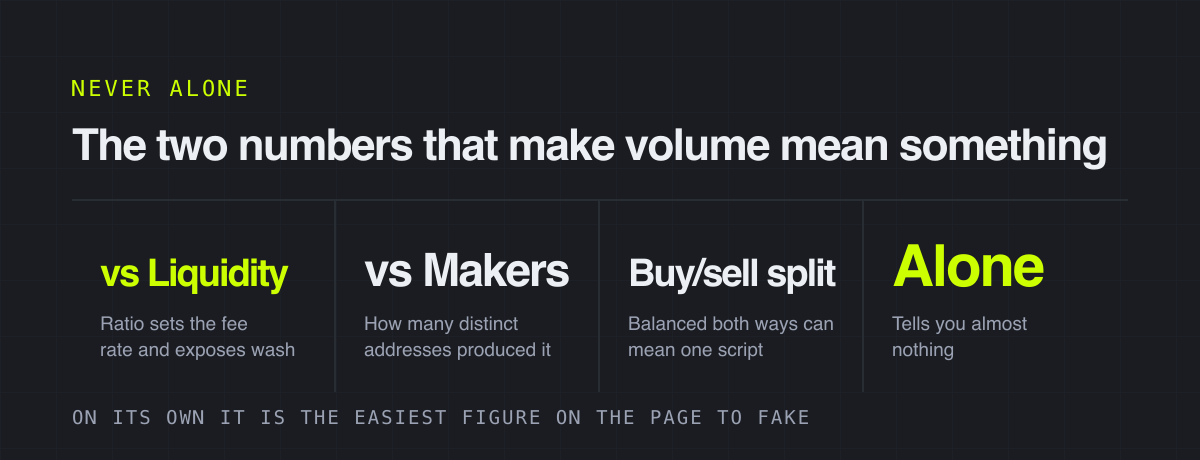
This is the single most useful comparison on the page. A pool with fifty thousand dollars of liquidity doing two million a day has turned over its entire depth forty times. That is possible for a token in a genuine frenzy and it is also exactly what a script produces, so the ratio is a question rather than an answer – but a token doing a hundredth of its liquidity in volume is quietly telling you nobody is trading it, which is an answer.
Reading it against makers
 Dexscreener publishes the number of distinct addresses that traded alongside the transaction count. Four hundred trades from twelve addresses and four hundred trades from three hundred addresses are different situations with the same volume, and the first one is visible in a second if you look at both columns.
Addresses are not people, so a high maker count can still be one person with a script and a budget. But a low one settles the question immediately.
Shapes worth recognising
- Volume that is near-perfectly balanced between buys and sells, hour after hour, on a token with no news.
- Trades arriving at an even cadence, which humans do not produce and scripts do.
- A volume spike with no change in holder count – activity without anybody new arriving.
- High volume with price flat on a thin pool, which takes deliberate effort to achieve.
- Volume concentrated in a window that matches when a paid promotion ran.
Where the number is still honest
On deep, established pairs, wash trading is expensive enough not to be worth it, and volume there does approximate real activity. The number is least trustworthy exactly where people most want it to be true: on small, new tokens where a large figure would be evidence of something taking off.
Using it properly
- Read liquidity first, always. It is the number your exit depends on.
- Then volume as a ratio to it, not as an absolute.
- Then makers against transactions, which takes one glance.
- Then the live trade feed on Dexscreener for thirty seconds, which shows the cadence a summary cannot.
- Treat a volume figure quoted without any of the above as advertising.
Tools mentioned
FAQ
What does volume mean in crypto?
The total value of trades executed in a period, usually 24 hours. It measures activity rather than interest – the same wallet buying and selling repeatedly adds to it on every leg, with only the pool fee and gas as the cost.
Can crypto volume be faked?
Yes, and cheaply. Wash trading between wallets produces genuine onchain volume that means nothing, and on a low-fee chain the cost is small relative to the appearance it buys. It is least worth doing on deep pairs and most worth doing on small new tokens.
How do you tell if volume is real?
Compare it with liquidity and with the maker count. Volume many times the pool's depth is either a genuine frenzy or a script; four hundred trades from twelve addresses answers the question immediately. Watching the live trade feed for half a minute shows a cadence that no summary figure does.
More from the blog
Arbitrum Orbit: The Stack Robinhood Chain Is Built On
Not a brand on a box. A specific set of choices about who orders transactions, where the data goes, and what you are trusting when you bridge in.
How to Swap Tokens, and the Four Screens That Matter
The swap itself is two clicks. Everything that decides whether it was a good one happens on the screens around it.
What a Contract Address Is, and Why It Is the Real Name
A token's name and ticker are text anyone can copy. The address is the only part that cannot be faked, which is why every safety check starts there.