Can You Buy Stocks With Crypto? Three Ways, One Caveat
Yes, and the three routes give you very different things – one of which is not a share at all.
The short answer
There are three routes. A broker that accepts crypto deposits sells you a real share held in a real account. A tokenized equity gives you a token tracking a share, issued by someone holding the underlying, tradable around the clock and on a chain. A synthetic gives you the price exposure with no share behind it at all. The caveat is the same in every case and it decides which route suits you: only the first makes you a shareholder. The other two make you a creditor of an issuer or a counterparty in a contract, with no voting rights and dividend treatment that depends entirely on the structure.
The question usually means one of two things: can I convert crypto into equities without a bank, or can I hold something that moves with a share while staying onchain. They have different answers.
Route one: a broker that takes crypto
Several platforms accept a crypto deposit, convert it, and buy a real share into a real brokerage account. You end up a shareholder with voting rights and ordinary dividend treatment, subject to market hours, identity checks and the settlement conventions of the exchange the share trades on.
This is the only route where the word stock is exactly accurate. It is also the one that puts you inside the traditional system, which is what a good portion of people asking the question were trying to avoid.
Route two: tokenized equities
A token tracking a specific share, issued by an entity that holds the underlying and honours redemptions. These trade on a chain, in a wallet, continuously – including on weekends, when the shares themselves are not trading anywhere.
On Robinhood Chain this is the consumer product rather than an institutional wrapper:  Robinhood Stock Tokens are ERC-20s sitting in the same wallet as everything else, which is why they end up in liquidity pools paired against memecoins, an arrangement that exists nowhere in traditional finance.
Route three: synthetics
A contract that pays the price of a share without anyone holding one – a perpetual on an equity index, or a derivative referencing a ticker. No custody, no redemption and no underlying, so the only thing that matters is whether the counterparty or the protocol can pay. Cheap, capital-efficient, and structurally the furthest from owning anything.
The differences that actually bite
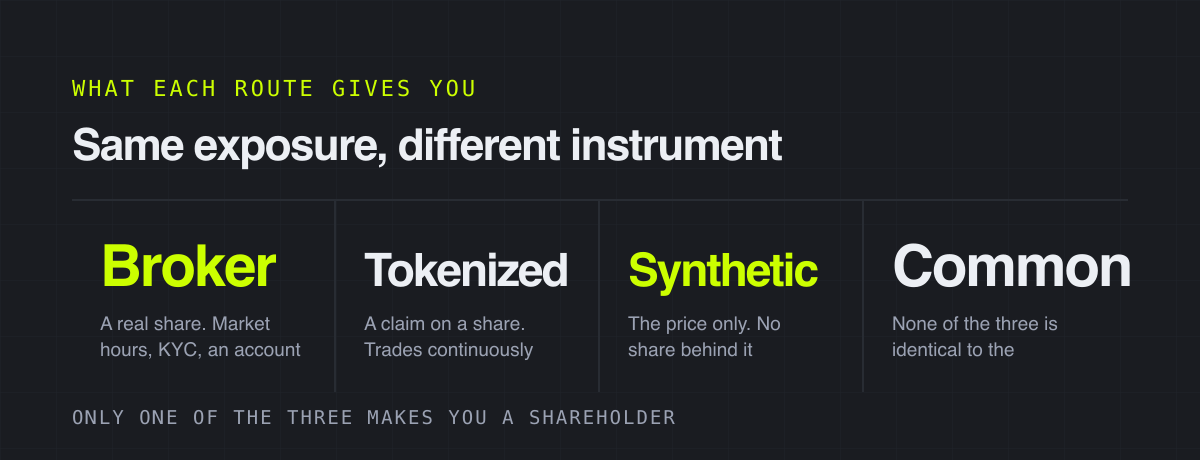
| Broker | Tokenized | Synthetic | |
|---|---|---|---|
| What you hold | A share | A claim on a share | A price exposure |
| Voting | Yes | No | No |
| Dividends | Paid as normal | Depends on the structure | Usually reflected in the price |
| Trading hours | Market hours | Continuous | Continuous |
| Main risk | Ordinary market risk | The issuer | The counterparty or protocol |
| Custody | The broker | Your wallet, with restrictions | Your wallet |
Which to use
- Building a long-term equity position: a broker. You want to be the shareholder, and the weekend closure is irrelevant over years.
- Trading around events that happen while markets are shut: tokenized, because that is the only route open then.
- Wanting equity exposure inside an onchain strategy – as collateral, or paired in a pool: tokenized, since it is a transferable token.
- Short-term directional exposure with leverage: synthetic –
 Arcus and
  Lighter are where that trades here – understanding that no share is involved anywhere.
 - Wanting to vote in a company you believe in: a broker, and only a broker.
The thing worth knowing before any of them
A price that moves identically does not make two instruments the same. Tokenized and synthetic exposure can track a share tick for tick for years, and the difference only appears at the edges – a corporate action, a dividend, a redemption, a counterparty in trouble. Those are exactly the moments people discover which one they were holding.
Tools mentioned
FAQ
Can you buy stocks with crypto?
Yes, in three ways. A broker that accepts crypto deposits buys you a real share; a tokenized equity gives you a token representing a claim on one, tradable continuously onchain; and a synthetic gives you the price exposure with no share behind it. Only the first makes you a shareholder.
Do tokenized stocks pay dividends?
It depends entirely on the structure. Some issuers pass them through, some reflect them in the token's price, and some do neither. It is set by the issuer's documentation rather than by anything on the chain, which is why it has to be read rather than assumed.
Are tokenized stocks the same as owning shares?
No. You hold a claim on a share held by an issuer, not the share. In practice the price tracks and the difference is invisible – until a corporate action, a dividend, a redemption or an issuer in trouble makes it visible all at once.
More from the blog
Social Trading vs Copy Trading: Not the Same Thing
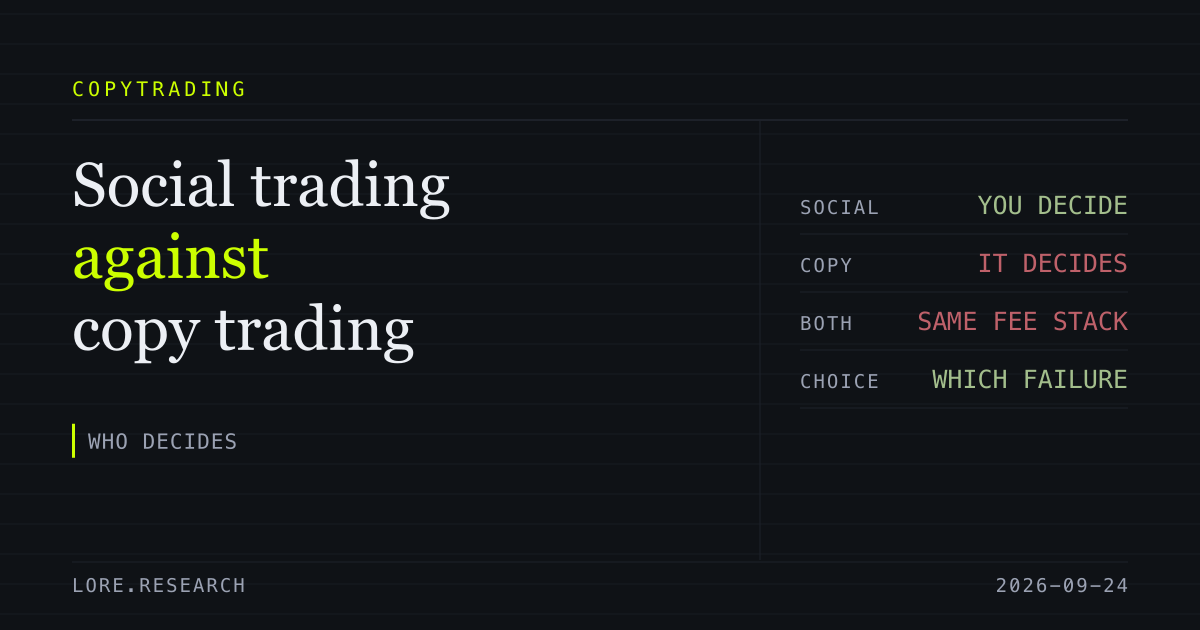
One shows you what people are doing and leaves the decision with you. The other takes the decision away. That difference is the entire product.
Reading a Memecoin Community Before You Buy Into It
A busy Telegram is not demand. Four things separate a community from a room that was paid to look like one.

RWA Tokens: What Is in the Basket, and What It Owns
Every list of real-world-asset tokens mixes three unrelated things. Sorting them takes one question, and most lists never ask it.