What an NFT Is Worth, and the Four Numbers That Answer It
Not the floor. The honest valuation is the best bid, adjusted for what makes your specific item different.
The short answer
An NFT is worth what someone will pay for it today, which is the best standing bid, not the floor price. Adjusting that for your item's traits using comparable recent sales gives a realistic range – and for most collections the realistic range is well below the number holders quote.
The question has a precise answer and an uncomfortable one, and they are the same answer. An NFT is worth what someone will pay. Everything else – the floor, what you paid, what it traded at in a better month – is context rather than value.
Start with the bid
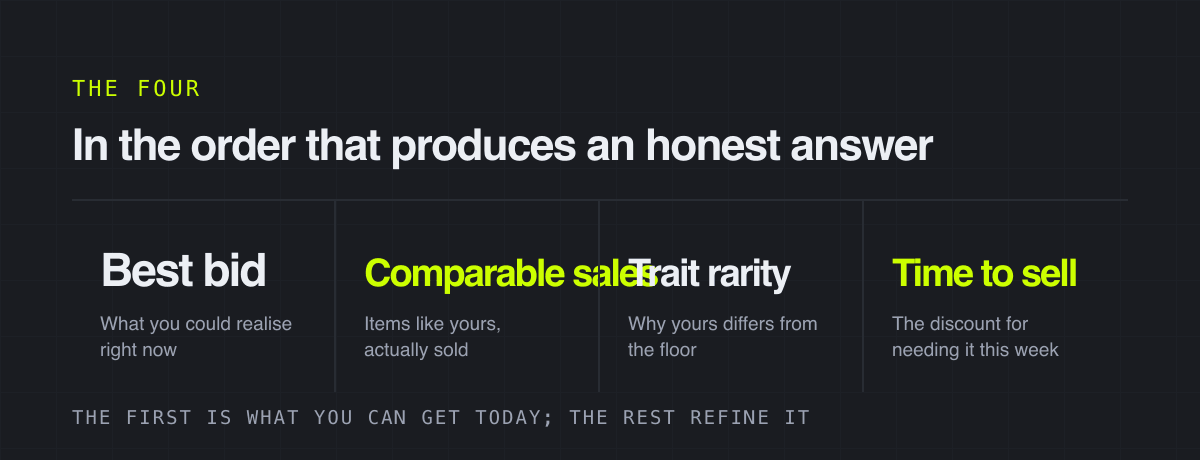
The best standing offer on a collection is the price at which you could convert to cash immediately. That number is frequently a fraction of the floor, and the gap between them is the clearest measure of how liquid the collection really is.
If the gap is large, the collection is illiquid and the floor is a number for people who are not transacting. If the gap is small, the floor is meaningful and the market is functioning.
Then find comparable sales
Items that actually sold, recently, with traits similar to yours. Three or four of them give a range, and the range is more honest than any single figure. A collection with no recent sales does not have a price – it has a last known price, which is a different thing.
Adjust for what makes yours different
Rarity matters, but not uniformly – it matters where the market has decided it does. A trait that appears in one percent of a collection is only worth a premium if buyers want that trait, and in most collections two or three attributes carry nearly all the premium while the rest are noise.
The way to find out is the same as everything else here: look at what items with that trait sold for, not at a rarity ranking.
| Number | What it tells you | How honest |
|---|---|---|
| Floor price | The cheapest ask today | Real, and about someone else's item |
| Best bid | What you can realise now | The most honest single number |
| Comparable sales | What the market paid for items like yours | The best estimate |
| Last sale of your item | History | Often irrelevant |
| What you paid | Your position | Not value at all |
The discount nobody prices
How fast you need to sell changes the answer. Listing patiently near comparable sales and waiting is one price; accepting the best bid today is another, usually much lower. Most people quote the first number and will eventually transact at the second.
- Check the best bid first. It is your floor in the only sense that matters.
- Find three comparable sales from the last month. If there are none, that is the answer.
- Look at trait premiums in sales rather than in a rarity score.
- Decide in advance whether you are a patient seller or a fast one. They are different prices for the same item.
- For holders and transfers without marketplace framing,
 Blockscout NFT Tokens shows the raw record.
Tools mentioned
FAQ
How do I find out what my NFT is worth?
Start with the best standing bid on the collection, which is what you could realise today, then adjust using recent sales of items with similar traits. The floor price is someone else's asking price for a different item.
Why is the best bid so much lower than the floor?
Because the floor is an ask and the bid is an offer. The gap between them measures how illiquid the collection is – a large gap means few real buyers at the prices being asked.
Do rare traits make an NFT more valuable?
Only where buyers have decided they do. In most collections two or three attributes carry nearly all the premium and the rest are statistical noise, so sales of items with that trait matter more than a rarity ranking.
What if a collection has no recent sales?
Then it does not have a price, only a last known one. An untraded collection's floor is an asking price nobody has tested, and it can sit at any level for as long as holders decline to sell.
More from the blog
Prediction Markets: A Price That Looks Like a Probability
A contract paying one dollar if something happens trades at the market's estimate of it happening. The gap between that and a forecast is where the money is.
Staking, and Why There Is None on This Chain
Staking pays you for securing a network. An L2 that settles to Ethereum and charges gas in ETH has nothing for you to secure.
Multisig: Removing the Single Point of Failure
Two of three signatures to move anything. It solves theft and loss at once, and introduces a problem of its own.