Scalping Onchain: Why the Fees Decide It Before You Do
A strategy that takes small repeated profits needs costs smaller than the profits. Onchain, that arithmetic almost never survives contact.
The short answer
Scalping means taking many small profits on short holds. Onchain each round trip pays gas twice, a pool fee twice and slippage twice, so the strategy requires a per-trade edge larger than the total cost – which on a volatile pair with a high fee tier is a demanding bar that most scalpers never calculate.
Scalping is a real strategy with a real logic: give up the large move in exchange for many small ones, and let frequency do the work that conviction does elsewhere. It works on venues where costs are a fraction of a basis point. Onchain it runs into arithmetic that almost nobody performs before starting.
The six charges
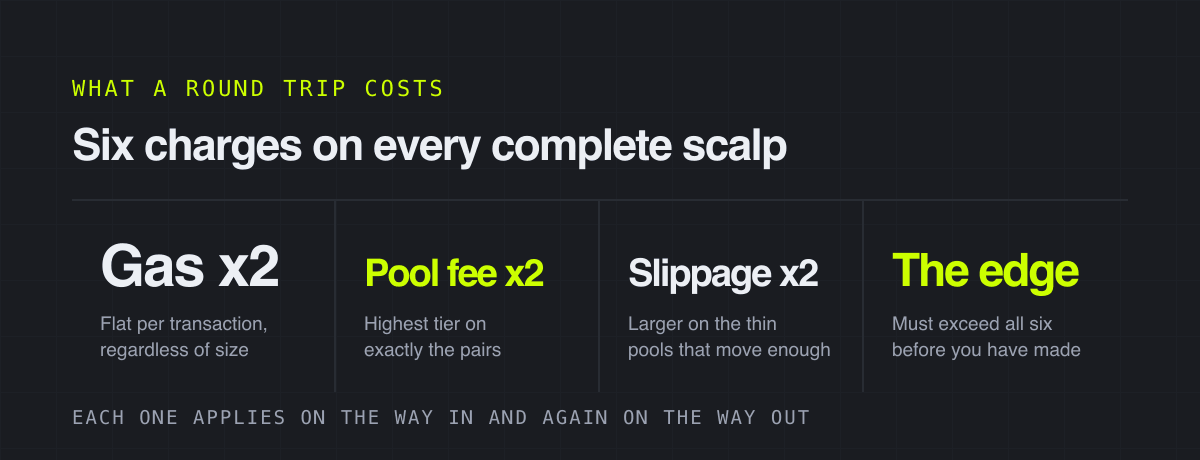
A complete scalp is two transactions. Each one pays gas, pays the pool's fee tier, and eats slippage. That is six charges to capture one move, and the whole premise of scalping is that the move is small.
The pool fee is the awkward one. Pairs volatile enough to scalp sit at the highest tier, because that is what compensates the liquidity providers for the volatility you are trying to trade. You are paying for the same property that makes the opportunity exist.
Slippage is worse than the quote suggests
The tokens that move enough to scalp are usually the ones with thin pools, and thin pools convert size into price impact quickly. You pay it entering and again exiting, and the second one arrives when you are trying to be fast.
Check depth before assuming a trade size is viable.  Dexscreener shows pooled liquidity next to volume, and the ratio between them tells you how much your own order will move the thing you are trading.
What the arithmetic demands
| Cost component | Applies | Scales with size? |
|---|---|---|
| Gas | Twice | No – flat |
| Pool fee | Twice | Yes |
| Slippage | Twice | Yes, worse than linearly |
| Being wrong | On some trades | Yes |
Because gas is flat, small scalps are dominated by it, which pushes you toward larger size. But slippage worsens faster than linearly with size, which pushes you back. There is a window where both are tolerable and it is narrower than people expect.
Where it can work
- Pairs with deep liquidity and a low fee tier, which are also the pairs that move least.
- A chain where gas is genuinely negligible – Robinhood Chain qualifies, and that changes one of the six but not the others.
- Size inside the window where gas is a small share and slippage has not begun to bite.
- A tracked win rate and average win, because without those two numbers you cannot know whether it is working.
The honest test
Record twenty round trips with every cost included, then compare the total against having made one position and held it for the same period. Most people running this strategy have never made that comparison, and it is the only one that answers whether the frequency is paying for itself.
There is no native stop loss to protect a scalp either, which means a strategy built on small controlled losses is running without the control. That is the second reason the arithmetic usually fails, and it is the one that fails suddenly rather than gradually.
Tools mentioned
FAQ
Is crypto scalping profitable onchain?
It can be, in a narrow window. Every round trip pays gas twice, the pool fee twice and slippage twice, so the per-trade edge has to exceed all six charges – a demanding bar on the volatile pairs that are worth scalping in the first place.
What is the best pair for scalping?
Deep liquidity and a low fee tier, which unfortunately describes the pairs that move least. The tension is structural: the fee tier that makes scalping affordable exists on pairs that do not move enough to scalp.
Does low gas make scalping viable?
It removes one of the six charges, which helps and is not sufficient. The pool fee and slippage both scale with position size and apply twice per round trip regardless of how cheap the transaction is.
Can you use a stop loss when scalping onchain?
Not natively. There is no order type that executes without you, so a strategy built on small controlled losses is running without the control – which is why losses in onchain scalping tend to arrive all at once.
More from the blog
Prediction Markets: A Price That Looks Like a Probability
A contract paying one dollar if something happens trades at the market's estimate of it happening. The gap between that and a forecast is where the money is.
Staking, and Why There Is None on This Chain
Staking pays you for securing a network. An L2 that settles to Ethereum and charges gas in ETH has nothing for you to secure.
Multisig: Removing the Single Point of Failure
Two of three signatures to move anything. It solves theft and loss at once, and introduces a problem of its own.