A Copy Trading Strategy: What to Decide Before You Mirror Anyone
Picking the wallet is the part everyone does. The three settings underneath it are what actually determine your result.
The short answer
A copy trading strategy is four decisions: which wallet, at what fixed size, with which trades filtered out, and on what evidence you stop. Wallet selection gets all the attention and decides the least – the same leader produces completely different results depending on the sizing and filter rules sitting underneath.
Every guide to copy trading is a guide to finding a wallet. Sort by profit, check the win rate, follow. Then people are surprised when following a wallet that made money loses them money, and conclude the wallet was fake. Usually it was not. The settings underneath were doing the damage.
Sizing: fixed, not proportional
The default in most tools is to copy a percentage of the leader's position. This sounds sensible and is the main reason copying goes wrong, because it hands your risk management to somebody who does not know you exist. When they take an outsized swing, so do you, at a moment you did not choose.
A fixed amount per copied trade is duller and works better. Every trade is the same size, your worst day is knowable in advance, and one conviction bet from the leader cannot become one from you.
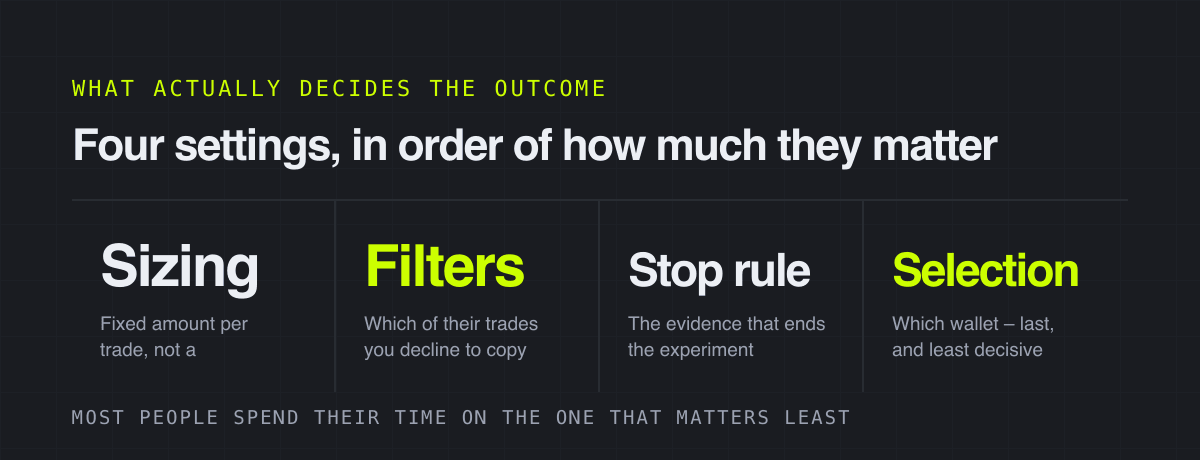
Filters: the trades you decline
A wallet does not only trade. It rotates, hedges, closes old positions and moves funds between its own addresses. A mirror reproduces all of it and charges you for the privilege, so the filter list is where a lot of the cost disappears.
- A minimum liquidity floor, below which you do not copy at all – thin pools are where slippage eats the trade.
- A maximum position size, so one unusual entry from them is not an unusual entry from you.
- A cap on trades per day. A leader having a busy session is not a reason for you to have one.
- No copying into tokens you already hold, which quietly doubles exposure you did not intend.
The stop rule, written before you start
Decide in advance what ends it. Not a feeling that it is not working – a number. A drawdown level, or a count of copied trades after which you assess regardless of where the PnL sits. Without one, a bad run becomes an argument with yourself, and the argument is always won by the side that wants to keep going.
| Decision | The bad version | The version that works |
|---|---|---|
| Size | A percentage of their position | A fixed amount you set |
| Scope | Every transaction they make | Only trades that pass your filters |
| Review | When it feels wrong | After a set number of trades, whatever the result |
| Stop | When you have had enough | At a drawdown level decided beforehand |
And then, last, the wallet
Selection matters, but less than the order of attention suggests. The filter is not headline profit – it is whether the record survives being adjusted for what a copier would actually have got.  Nock Scout ranks wallets by what a one to three ETH copier would have made rather than by the leader's own returns, which is the correct adjustment and a very different leaderboard.
 Cielo Finance is the lighter version of the same thing: alerts on a handful of wallets, read rather than executed. Watching a wallet for two weeks before mirroring it is the cheapest due diligence available, and almost nobody does it.
Start with one
One wallet, fixed size, filters on, stop rule written down. Not five wallets, because five wallets is a portfolio you did not design and cannot explain. The point of the first month is not returns – it is finding out whether your settings survive a real drawdown, which is information you can only buy by running it.
Tools mentioned
FAQ
What is a good copy trading strategy?
Fixed size per trade rather than a percentage of the leader's position, filters that decline their thin-liquidity and oversized entries, a stop rule written before you start, and one wallet rather than several. Selection matters less than any of those.
Should I copy a percentage of the trader's position?
Usually not. Proportional sizing transfers their risk appetite onto your account, including conviction bets sized for a portfolio and a time horizon you do not share. A fixed amount per trade makes your worst day knowable in advance.
How many wallets should I copy at once?
One, at least at first. Several wallets copied simultaneously produce a portfolio nobody designed, with overlapping positions you cannot see and no way to tell which leader caused which result.
When should I stop copying a wallet?
At a drawdown level or trade count you decided before you started. Deciding mid-run means deciding while losing, which is when the decision is worst.
More from the blog
Tokenized Bonds Beyond Treasuries: Credit, Coupons and Who May Hold Them
A tokenized treasury is a short government loan with no credit question. Everything else in the bond market has one, and it changes the product.
Tokenized Private Credit: The Yield Is Someone Else's Loan
The highest yields in RWA come from the part with no public market, no daily price and no easy exit. That is not a coincidence.
Tokenized Commodities: What Is Behind the Barrel
Gold sits in a vault. Oil does not sit anywhere convenient, which is why almost every oil token is a fund and not a barrel.