What a Token Scanner Catches, and What It Cannot
A green score means no known pattern was found. That is a much smaller claim than the colour suggests.
The short answer
Automated token scanners test a contract against known bad patterns – transfer blocks, mint functions, unlocked liquidity, fee traps – and simulate a buy and sell. They catch mechanical scams reliably and cannot detect intent, social risk, or a contract designed to behave differently under simulation than in production.
Automated contract scanners are genuinely useful and routinely misread. They answer one question well – does this contract contain a known mechanism for taking your money – and people treat the answer as a verdict on the token, which is a different and much larger question.
What they actually do
Two things. They read the contract for patterns: functions that block transfers, an owner who can mint more supply, adjustable fees, a blacklist, an unrenounced owner with meaningful powers. And they simulate a buy followed by a sell, to check the sell actually completes and at what cost.
Both are mechanical checks against a known list, and on that list they are fast and reliable.  HoodScan and
  Fomo Helper do this for Robinhood Chain; the equivalent tools exist on every chain and work the same way.
Where the list ends
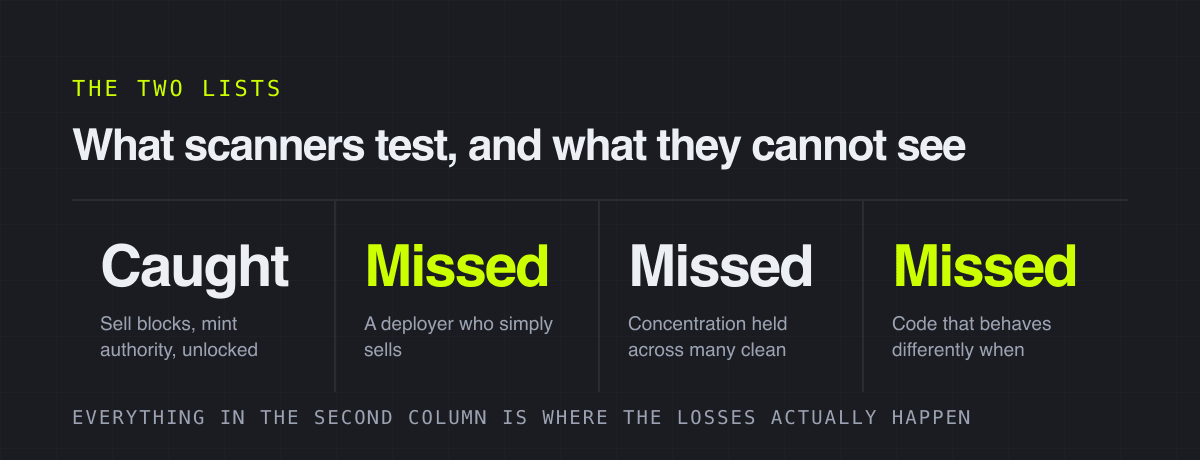
The failure that costs most people money is not a mechanism in the code. It is a deployer with a large position who sells it. That is not a vulnerability, it is a transaction – perfectly ordinary, indistinguishable from any other sale, and invisible to a scanner because there is nothing wrong with the contract.
The three blind spots worth naming
Concentration spread across clean wallets passes every check. Each address is unremarkable, the contract is fine, and one person holds a third of supply. That is a clustering question rather than a code question, which is why  Bubblemaps and a scanner answer different halves of the same problem.
Simulation-aware code is rarer and real. A contract can check whether it is being called in a simulated context and behave itself, then behave differently in production. Any scanner that relies on a dry run inherits that limitation by construction.
And social risk is entirely outside the frame. A token whose entire case is a person posting about it is exposed to that person stopping, and no amount of contract analysis will see it coming.
| Risk | Scanner sees it? | What does |
|---|---|---|
| Cannot sell at all | Yes, reliably | The simulation |
| Owner can mint more | Yes | Reading the functions |
| Liquidity not locked | Yes | Checking the LP tokens |
| Deployer holds 30% | Partly – as one address | Reading the deployer directly |
| Supply split across 200 wallets | No | Clustering by funding source |
| Nobody cares in a week | No | Nothing. That is the market |
False positives are a real cost
The other direction matters too. Legitimate contracts get flagged for having an owner function they need, a fee mechanism that pays holders, or an unusual pattern the scanner has not seen. Treating every flag as disqualifying means missing things; treating none of them as disqualifying means being robbed by the obvious. The flags are inputs.
How to use one properly
- Run the scanner first, because it is thirty seconds and it eliminates the mechanical scams.
- Read the specific flags rather than the score. A single red on 'owner can change fees' is a different fact from a red on 'sell fails'.
- Then do the two things it cannot: check the deployer's address, and check whether supply is concentrated across wallets sharing a funder.
- Treat a clean report as 'no known mechanism found', which is exactly and only what it means.
Used that way, a scanner is the cheapest filter available. Used as a verdict, it is a way of being confident about the wrong risk.
Tools mentioned
FAQ
What does a token scanner check?
Known bad patterns in the contract – blocked transfers, mint authority, adjustable fees, blacklists, unlocked liquidity – plus a simulated buy and sell to confirm selling works and at what cost.
Does a green score mean a token is safe?
No. It means no known mechanism for trapping your funds was found. A contract can be technically flawless while one wallet holds a third of supply and is about to sell it.
Can token scanners be fooled?
Yes, in two ways. A contract can be written to detect a simulated call and behave differently in production, and supply concentration spread across many individually clean wallets passes every mechanical check.
What should I check that a scanner cannot?
The deployer's address – what it holds, where it was funded from and what else it launched – and whether the holder base is genuinely many people or one person across many addresses. Both need a different kind of tool.
More from the blog
Tracking Whale Wallets Without Mistaking Size for Skill
A large balance is evidence of a large balance. Whether it means anything about the next trade is a separate question, and usually the answer is no.
Wallet Tracking You Will Actually Read
Everyone sets up alerts. Almost nobody survives the second week, because the setup was designed to catch everything.
Risk-Reward on a Token With No Floor
The ratio assumes you know where you get out. On a DEX with no stop loss, half the formula is missing – and it is the half that matters.