How to Start Trading Memecoins
Six things to set up before the first buy, in the order that stops the common mistakes.
The short answer
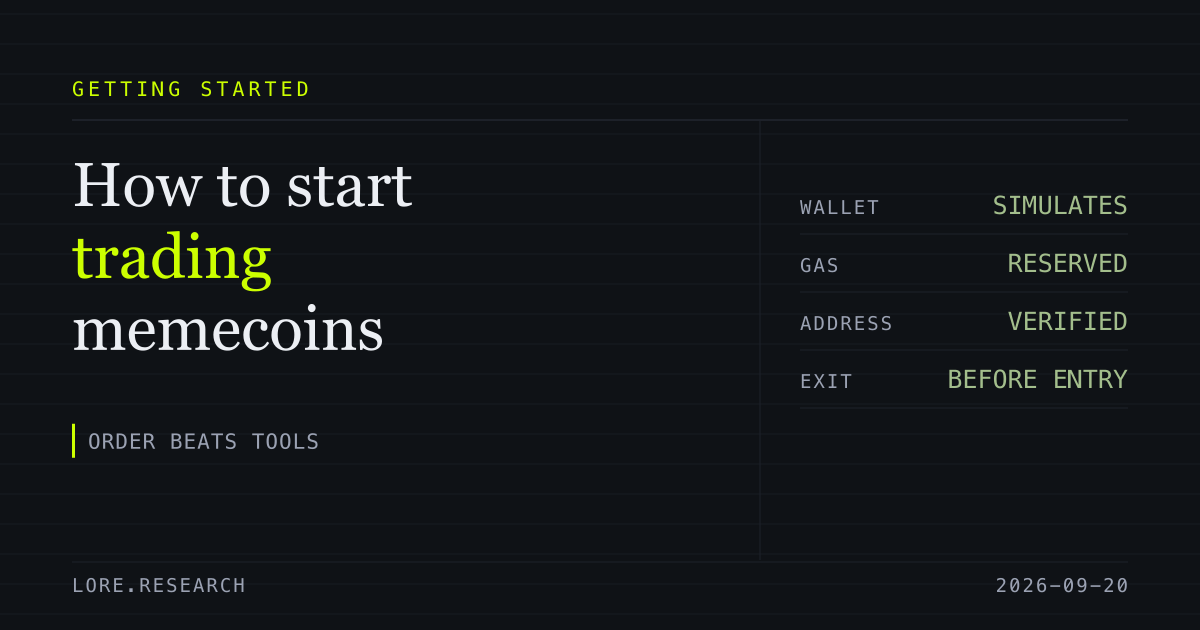
The order matters more than the tools. Set up a wallet that simulates transactions before signing, fund it with an amount you have written off, add the network and keep a gas reserve you never trade, learn to verify a contract address on the block explorer, use a screener to find and check tokens rather than a feed to be told about them, and decide your exit before your entry. Most people start at the buy button and work backwards, which is why the first losses are to honeypots and mis-sized positions rather than to the market being against them.
Nearly every guide to this starts with which terminal to open. That is the last decision, not the first, and starting there is why the first few hundred dollars usually go somewhere avoidable.
One: a wallet that shows you what you are signing
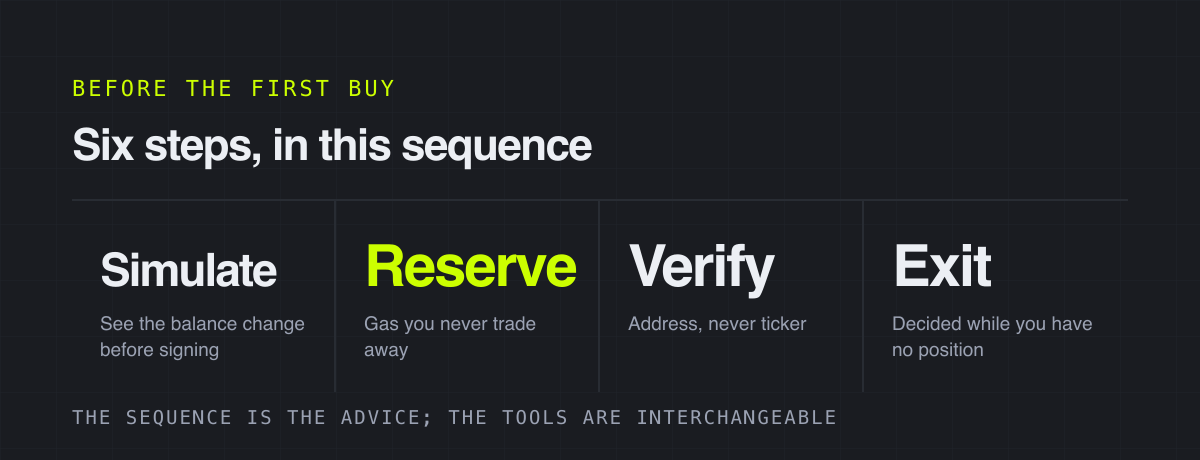
Use a wallet that simulates the transaction and tells you what your balances will look like afterwards – Rabby does this well. Almost every catastrophic signature is one the owner would have refused if they had been shown its effect in plain language. This single choice removes a whole category of loss and costs nothing.
Two: an amount you have already written off
Not an amount you can afford to lose in the abstract sense. An amount you have mentally spent. This is the only position-sizing rule that survives contact with a token that is up four hundred percent, and it is the reason experienced traders look unemotional – they decided how much this could cost them before it started costing.
Three: the network and a gas reserve
Add Robinhood Chain – chain ID 4663 – and bridge ETH for gas. Then set aside a reserve you never trade. The failure this prevents is specific and common: swapping everything into a token and finding there is nothing left to pay for the transaction that sells it.
Four: verify by address, never by ticker
Tickers are not unique and creating a convincing duplicate costs nothing. Copy the contract address from a source you trust, paste it into the block explorer, and confirm it is what you think it is before you trade it. This is the habit that separates people who have been trading for a year from people who have been trading for a week.
Five: find with a screener, decide with the explorer
Dexscreener shows what exists and how deep its liquidity is, without taking a cut of your trade or having an opinion about what you buy. A terminal like GMGN adds holder analysis and a buy button for a fee, which is worth paying when you are working new launches and worth nothing when you already know what you want. Neither replaces reading the contract.
Six: decide the exit first
Write down, before buying, what price or what event makes you sell – both directions. The reason to do it first is that you cannot do it later: once you hold a position, every number you choose is chosen by someone who owns the thing. Taking partial profit mechanically is unglamorous and is most of the difference between traders who last and traders who do not.
Only now, the tools
- A screener to find and check. Dexscreener or GeckoTerminal.
- An explorer to verify. Blockscout, every time, before buying.
- A terminal when speed matters. GMGN for breadth, Axiom for execution.
- A scanner before anything unfamiliar. HoodScan and a holder map.
- An approval manager used regularly. Revoke.cash.
That stack is five tools, three of them free, and none of them is the reason someone makes or loses money. The sequence above is.
Tools mentioned
 Rabby
Rabby Dexscreener
 GMGN
GMGN GeckoTerminal
 Axiom
Axiom HoodScan
 Revoke.cash
FAQ
How much money do I need to start trading memecoins?
Enough to make the position meaningful to you and small enough that losing all of it changes nothing about your month. The number differs per person, and the test is whether you would still sleep with the position open.
How do I buy a memecoin safely?
Verify the contract address on the explorer rather than searching the ticker, check that ordinary addresses have successfully sold it, size the position for total loss, and use a wallet that simulates the transaction before you sign it.
Do I need a trading bot to start?
No. A bot buys speed, which matters on launches and nowhere else. Starting without one means you will be slower and will make better decisions, which at the beginning is the better trade.
More from the blog
What “Smart Money” Means, and When the Label Lies
A wallet that made money is not the same as a wallet that knows something. Telling them apart is the whole skill.
What to Do After a Rug Pull
Nothing gets the money back. Several things stop the next hour being worse than the last one.
How to Spot a Crypto Honeypot Before You Buy
A token you can buy and cannot sell. The tell is in the contract, and it is readable in about a minute.