
Liquidity Ladder
A row of Uniswap positions across a price range instead of one, managed together. For people who decided a single range is a single guess.
Your own walletPool fee and gas per positionRobinhood Chain +2
What is Liquidity Ladder?
Liquidity Ladder builds and manages ladders of concentrated liquidity positions on Uniswap and PancakeSwap v3/v4 – up to fifty at once, spread across a span of prices, with PnL reported across the whole set rather than per position. The problem it solves is structural: a v3 position earns fees only while price sits inside its range and nothing once price leaves, so a single range is a bet on where price will sit. A ladder spreads that bet, and doing it by hand means opening and tracking every position separately.
Use it when
- You are providing liquidity actively rather than depositing once and leaving
- A single range keeps going out of range and you are tired of rebuilding it
- You want PnL across a set of positions rather than a number per position
- You want to manage from a phone as well as a desktop
Skip it when
- You have not read impermanent loss yet. Tooling makes placement precise, not free
- Your position is small enough that gas on fifty positions outweighs the spread
- You want a vault to decide the strategy for you – this gives you control, not automation
And if you do:
- Impermanent loss is arithmetic and no placement tool removes it
- Fifty positions is fifty times the gas to enter and to exit
- A ladder that is well placed for a range is badly placed for a breakout out of it
- More positions means more approvals and more contract interactions than a single deposit
What you are actually paying for
The pool fee and gas apply per position, which is the real consideration: a fifty-position ladder is fifty transactions to open and fifty to close. On an L2 that is affordable and on a small position it is not. Against it sits the reason for the ladder – fee income that keeps accruing when a single range would have gone quiet.
Setting it up
- Decide the range you actually believe in before opening anything. The tool places positions; it does not choose the thesis.
- Check the pool's volume against its liquidity first – that ratio is what the fees are paid out of.
- Read the divergence cost at both edges of your span, not only at the current price.
- Start with a short ladder. The rebalancing behaviour is easier to judge on five positions than on fifty.
- Watch what happens when price leaves the span entirely, which is the case the ladder exists for.
Liquidity Ladder FAQ
What is a liquidity ladder?
A row of concentrated liquidity positions spread across a span of prices rather than one position in a single range. Some stay in range as price moves, so fee income continues where a single range would have stopped earning entirely.
Does Liquidity Ladder support Robinhood Chain?
Yes – it operates on Robinhood Chain alongside BSC and Base, on Uniswap and PancakeSwap v3/v4 pools.
Does a ladder avoid impermanent loss?
No. Divergence is arithmetic and applies to every position in the ladder. What a ladder changes is how precisely liquidity is placed and how quickly it can be moved, and those decide whether fee income outruns the divergence.
Guides that use Liquidity Ladder
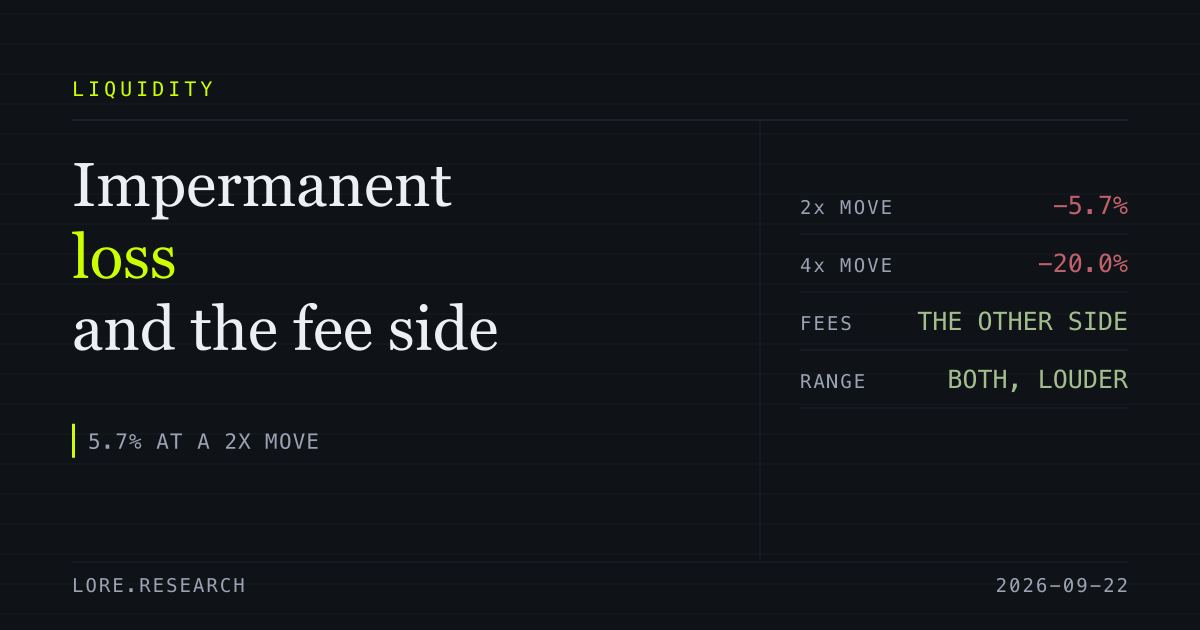 Impermanent Loss: The Number That Decides LP FarmingNot a fee and not a hack – arithmetic. Providing liquidity pays you in trading fees and charges you for the price moving, and only one of those is visible while it happens.
 What a Liquidity Pool Is, and Who Is on the Other SideThere is no order book and nobody matching buyers to sellers. Every trade you make onchain is against a contract holding two piles of tokens, and somebody owns those piles.
What Liquidity Ladder works well with
 DexscreenerVolume against liquidity on the pool, which is what the fee income is paid out of.
 DefiLlama YieldsThe neutral scoreboard for comparing a pool against every other one.
 RabbyFifty positions is fifty signatures. Reading each one matters more at that count.


